FAVN and RFFIT both measure rabies neutralising antibodies, both pass at 0.5 IU/ml, and the WOAH manual treats them as equivalent. The difference is administrative, not scientific. Most rabies-free destinations name FAVN by itself; Japan accepts either. And because no laboratory in Malaysia is approved to issue the result, your destination's list decides which test your pet gets — not your vet.
Introduction: who actually chooses the test?
FAVN vs RFFIT is almost never a decision the pet owner makes. Both tests answer the same question — has this animal built enough rabies antibody — and both use the same 0.5 IU/ml pass mark. What differs is which one the destination will accept on paper.
Owners come to My Pet Mover having read two lab acronyms on a destination checklist and quite reasonably want to know which is better. It is the wrong question, though it is a very understandable one.
Neither test is better. They are two accepted ways of running the same neutralisation assay, and the World Organisation for Animal Health lists both as prescribed tests for international movement. A pet that passes one would pass the other.
The thing that decides your file is narrower and more bureaucratic: which method the importing authority names, and which laboratory it will accept that method from. Get either wrong and a perfectly good 2.4 IU/ml result is worth nothing at the border. That is the part of exporting a pet from Malaysia that catches people out.
Before we open the rules, here is a short veterinary explainer of what the blood test is measuring in the first place.
What does the FAVN test actually measure?
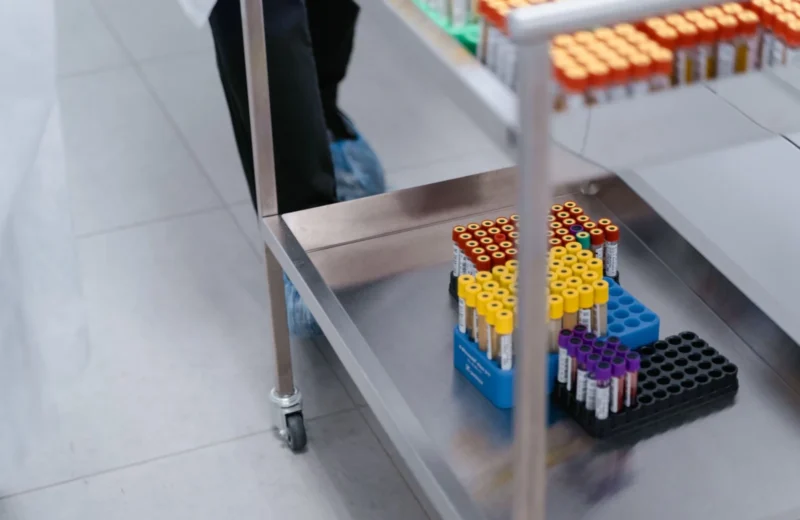
FAVN stands for Fluorescent Antibody Virus Neutralisation. It mixes your pet’s serum with live rabies virus in a 96-well plate, then reads how far the serum can be diluted and still stop the virus infecting the cells. The answer is reported in international units per millilitre.
The logic is simple even if the laboratory work is not. Serum from a well-vaccinated animal contains antibodies that neutralise rabies virus. Dilute that serum enough and it stops working. The dilution at which it stops working is the titre.
FAVN runs this as a microplate method on BHK-21 cells, and the protocol is written into the WOAH Terrestrial Manual chapter on rabies. Because the protocol is standardised internationally, a FAVN result issued in Kansas means the same thing as one issued in France.
- The pass mark is 0.5 IU/ml. This is the WHO and WOAH threshold for an adequate response to vaccination, and virtually every importing authority has adopted it verbatim.
- It is a response test, not a disease test. A titre tells you the animal reacted to its vaccine. It does not certify the animal is free of rabies.
- It is tied to a microchip, not a name. The chip number goes on the sample tube and on the certificate, which is what makes the result belong to your animal.
That last point matters more than owners expect. Kansas State’s rabies laboratory cancels unlabelled pet-travel tubes outright, with no exceptions. A cancelled sample means a fresh draw and a fresh wait. For several of the destinations in our guide to which countries require a cat rabies titer test, that alone pushes a departure back by months.
Not sure your destination even needs this test?
Roughly half the owners who ask us about titres are moving somewhere that does not require one. Check your export requirements first →
How is the RFFIT test different?
RFFIT stands for Rapid Fluorescent Focus Inhibition Test. It is the same neutralisation principle read on a different cell system, and it grew up in human medicine — monitoring vaccinated vets, lab staff and travellers rather than clearing animals for export.
The mechanics run in parallel. Serum is diluted, mixed with a fixed quantity of live rabies virus, and whatever neutralising antibody is present knocks the virus out. What is left is stained and counted.
The WOAH manual is explicit that FAVN and RFFIT give equivalent results, and it accepts RFFIT run on BHK-21 cells as well as on the neuroblastoma cells the test traditionally used. So the two are not rivals in any scientific sense.
Where they part company is in how the answer is packaged. Kansas State offers RFFIT in two forms. The endpoint version gives a precise figure between 0.1 and 15.0 IU/ml. The cheaper screen version only reports which side of a threshold the animal falls on. A screen result is fine for a clinician and useless for a border officer, because import certificates ask for the actual number.
That is why RFFIT tends to sit in the human column of a laboratory’s price list and FAVN in the animal one. Japan is one of the few major destinations that accepts either, as our piece on Japan’s titer test and the long delay it creates explains.
FAVN vs RFFIT, side by side
Set FAVN vs RFFIT against each other and most rows come out identical — same principle, same units, same 0.5 IU/ml threshold, same WOAH standing. The rows that differ are the practical ones: cell system, reporting format and, above all, who accepts the result.
FAVN and RFFIT Compared, Row by Row
| Attribute | FAVN | RFFIT | Same? |
|---|---|---|---|
| Full name | Fluorescent Antibody Virus Neutralisation | Rapid Fluorescent Focus Inhibition Test | — |
| What it measures | Rabies virus neutralising antibody | Rabies virus neutralising antibody | Yes |
| Pass threshold | 0.5 IU/ml | 0.5 IU/ml | Yes |
| WOAH standing | Prescribed test | Prescribed test | Yes |
| Plate format | 96-well microplate | Chamber slide or microplate | No |
| Cell system | BHK-21 | Mouse neuroblastoma, or BHK-21 | No |
| Reporting format | Numeric titre only | Numeric endpoint, or a screen result | No |
| Primary users | Animal export and quarantine | Human occupational monitoring | No |
| Named on pet import rules | Almost universally | Occasionally, alongside FAVN | No |
| Available inside Malaysia | No approved laboratory | No approved laboratory | Yes |
Source: My Pet Mover, compiled from the WOAH Terrestrial Manual rabies chapter and published laboratory guidance, 2026.
Six of the ten rows above are identical. That is the honest summary of FAVN vs RFFIT as science. The four rows that differ are the ones that decide whether your pet flies — and the last row is the one that reframes everything for a Malaysian owner.
Whichever method your destination names, the serum is leaving Malaysia either way.
Owners planning a European move sometimes ask whether they can hedge by ordering both. You can, and the extra cost is rarely worth it. Files bound for Germany and the wider EU are cleanest when a single FAVN certificate from a designated laboratory sits in the folder.
Which test does your destination accept?
Most destinations that require a titre name FAVN and stop there. Japan is the notable exception, accepting FAVN or RFFIT from a laboratory its agriculture ministry has designated. Where a rule names only FAVN, an RFFIT certificate will not be substituted, however good the number is.
Accepted Test Method by Destination, for Pets Leaving Malaysia
| Destination | Method named | Wait after sampling |
|---|---|---|
| Group A — FAVN named, RFFIT not offered as an alternative | ||
| European Union | Titration at a designated lab | 3 months |
| United Kingdom | Titration at a designated lab | 3 months |
| Australia | RNATT, FAVN in practice | 180 days |
| New Zealand | FAVN | 180 days |
| Hawaii and Guam | FAVN only | Varies by programme |
| Group B — FAVN or RFFIT both accepted | ||
| Japan | FAVN or RFFIT | 180 days |
| Taiwan | Neutralising antibody test | 180 days |
| Group C — no titre required from Malaysia | ||
| Singapore | Not required | None |
| Most Gulf states | Not required | None |
Source: My Pet Mover, compiled from destination authorities’ published pet import conditions, 2026. Confirm current conditions before booking; rules change without notice.
Japan sits in Group B for a reason worth understanding. Its agriculture ministry names FAVN and RFFIT as accepted methods but restricts testing to laboratories it has designated by name, and warns that a micro-scale RFFIT variant does not qualify. Method flexibility, laboratory rigidity.
The EU works the other way. Instead of arguing about assay names it publishes a list of designated laboratories, and requires sampling at least 30 days after vaccination and at least three months before travel. Our walkthrough of sending a pet from Malaysia to the EU sets those dates against the rest of the file, and China’s rabies titer requirements follow their own pattern again.
Want the titre priced into the whole move?
The test is one line on a much longer bill, and it is rarely the biggest one. See our pet relocation pricing →
Why the laboratory matters more than the method
Importing governments accept results from laboratories they have approved by name, not from any competent laboratory. No facility in Malaysia currently sits on the lists most exporters need, so every sample drawn here leaves the country before it is read.
This is what makes the FAVN vs RFFIT debate feel abstract once you are actually shipping. Your Klang Valley vet draws the blood, spins the serum and packs it. The result comes from somewhere else entirely.
Approval is granted to a building, not to a technique. A laboratory earns its place on the European Commission’s designated list, or Japan’s ministerial list, through proficiency testing and audit. A neighbouring laboratory running the identical protocol without that approval produces a certificate no border will read.
Three practical consequences follow.
- Your clinic’s choice of reference lab decides your method. Most Malaysian clinics have one established route for serum. That route determines whether you get FAVN or RFFIT, long before anyone discusses the science.
- Courier time is part of the timeline. Serum has to travel refrigerated and arrive within the laboratory’s working week. A Friday draw often means a Monday departure and a week lost.
- The bill is stacked, not single. Draw, packing, laboratory fee and courier are four separate charges, which is why titer test quotes in Malaysia vary so widely.
What makes a passing titre invalid
A titre can read 3.0 IU/ml and still be rejected. The usual reasons are a microchip implanted after the blood draw, a sample taken too soon after vaccination, an unapproved laboratory, or a certificate that has aged past the destination’s validity window.
Owners assume the number is the result. In practice the number is one field on a certificate that has to be internally consistent with several dates.
The sequence rule is the strictest. Microchip first, vaccinate second, sample third. If the chip was implanted after the rabies vaccination, most authorities treat that vaccination as unverifiable and the whole chain has to restart.
Then there is the interval question. Kansas State recommends 10 to 21 days between a booster and the blood draw for the strongest reading. The EU separately sets a floor of 30 days after primary vaccination. Two different clocks, and they do not cancel each other out.
Validity is the last trap. Japan treats a passing result as valid for two years from the sampling date, provided vaccination stays current. Other destinations tie validity to the vaccination lapsing instead, which sounds generous until a booster is given a day late.
How the sampling date sets your departure date
The clock that governs your move does not start when results arrive. It starts on the day the blood was drawn. A 180-day destination counts from that date, so laboratory turnaround eats into your visibility, never into the waiting period itself.
Earliest Departure, Counted from the Blood Sampling Date
| Week | What happens | Status of the file |
|---|---|---|
| Week 0 | Blood drawn, serum packed and couriered out of Malaysia | Clock starts here |
| Week 1 | Sample logged in at the overseas laboratory | Nothing to do |
| Weeks 2–4 | Test run, certificate issued and returned to the clinic | Pass or fail known |
| Week 13 | Three-month EU and UK waiting period completes | Europe now open |
| Week 26 | 180-day waiting period completes | Japan, Australia, NZ open |
| Final 10 days | Vet examination, DVS endorsement, import permit and booking | Cleared to fly |
Source: My Pet Mover, modelled on standard export sequences from Malaysia, 2026. Illustrative; laboratory turnaround and endorsement lead times vary.
One thing stands out in that table. Between roughly week 4 and week 13, nothing happens at all. That dead stretch is where most owners discover their titre failed, having already booked movers and a flight.
It is also why a current titre on file is the most valuable document an expatriate family in Malaysia can hold. Households that keep one live can reach a destination like Australia in weeks rather than half a year.
Working backwards from a fixed departure date?
Send us the destination and the date and we will tell you whether the titre still fits. Compare lead times by route →
What actually moves a borderline titre
Vaccination history moves the number more than anything else. Two or more rabies vaccinations behind the animal, with the sample drawn 10 to 21 days after the latest one, gives a far better chance of clearing 0.5 IU/ml than a single vaccination sampled at a random date.
Relative Chance of Clearing 0.5 IU/ml, by Preparation Pattern
| Preparation pattern | Relative chance of passing | Rating |
|---|---|---|
| Three or more vaccinations, sampled day 10–21 | Very strong | |
| Two vaccinations, sampled day 10–21 | Strong | |
| Two vaccinations, sampled months later | Moderate | |
| Single primary vaccination, sampled day 14–30 | Uncertain | |
| Single vaccination, elderly or immunosuppressed pet | Weak |
Source: My Pet Mover, illustrative ranking built on published laboratory guidance on vaccination history and sampling intervals, 2026. Comparative, not measured pass rates.
There is a second reason to prefer a well-vaccinated animal, and it is about measurement rather than immunity. A published comparison of the two methods in exported dogs and cats found no difference at high antibody levels. Below 1.0 IU/ml, though, both showed real test-to-test variation.
Borderline animals are where both tests get noisy. An animal comfortably above the line passes on either method, every time. An animal hovering near 0.5 IU/ml can pass one week and fail the next on the same assay. If your pet comes back at 0.6, treat it as a warning rather than a win. Our guide on what to do if your pet fails the rabies titer test is worth reading before you book anything.
How to get the titre right the first time
Five steps, in this order, prevent almost every failed titre we see. Confirm the destination’s rule, confirm the laboratory, check the microchip, time the booster, then draw. Skipping straight to the blood draw is what costs families six months.
Run these in sequence with your vet before anyone reaches for a needle.
- Confirm what your destination actually requires. Find the current import conditions and note the method named, the laboratory list referenced and the waiting period counted from sampling.
- Confirm which laboratory your clinic uses. Ask for the name, then check it appears on your destination’s published list. Change clinics if it does not.
- Verify the microchip is already implanted and readable. It must predate the rabies vaccination you intend to rely on, and its number must go on the sample tube.
- Time the booster deliberately. For most pets, a booster followed by a draw 10 to 21 days later gives the strongest reading, while still clearing the destination’s minimum interval after primary vaccination.
- Draw early in the week. Serum leaving Malaysia on a Monday or Tuesday reaches an overseas laboratory inside its working week; a Friday draw usually loses several days in transit.
None of this changes the FAVN vs RFFIT answer. It changes whether the answer arrives in time to be useful.
Conclusion
FAVN vs RFFIT is a question with a short answer and a long footnote. The short answer is that they are equivalent. The long footnote is that acceptance, laboratory approval and sampling dates decide your file, and those three sit entirely outside the laboratory bench.
If you take one thing from this page, make it the order of operations. Destination rule, then laboratory, then microchip, then vaccine timing, then the draw.
The families who move smoothly are rarely the ones who understood the assay best. They are the ones who drew blood in month one instead of month five. Our pet export service from Malaysia exists mostly to make that happen on time.
Frequently Asked Questions
1. Is FAVN or RFFIT more accurate?
Neither. The WOAH manual lists both as prescribed tests and states they give equivalent results. Published comparisons found no difference in sensitivity or specificity for animals with high antibody levels. Both methods do show test-to-test variation in animals sitting below 1.0 IU/ml, which is a property of borderline immunity rather than of one assay being weaker.
2. Can I submit an RFFIT result if my destination asks for FAVN?
No. Where an import rule names FAVN specifically, an RFFIT certificate will be refused even though the underlying science is the same. Some laboratories decline RFFIT submissions for pet travel outright for this reason. Check the wording of your destination’s current import conditions before the sample is drawn, not after.
3. Can a rabies titer test be done in Malaysia?
The blood draw happens here; the test does not. No laboratory in Malaysia currently appears on the approved lists that importing authorities publish, so serum is packed and couriered overseas for analysis. Your clinic’s established reference laboratory usually determines both the method used and the total turnaround time.
4. How long does a FAVN result take to come back?
Budget three to five weeks from the blood draw to the certificate reaching your clinic. That covers courier time out of Malaysia, laboratory turnaround and the return of the paperwork. Because destination waiting periods count from the sampling date rather than the result date, this turnaround does not add to your wait.
5. What titre does my pet need to pass?
0.5 IU/ml or higher, on either method. This is the WHO and WOAH threshold for an adequate response to rabies vaccination and virtually every importing authority uses it. Treat a result between 0.5 and 1.0 IU/ml as a pass you should not rely on for a second trip, since borderline readings vary between tests.
Not sure which test your pet needs?
Tell us the destination and your pet’s vaccination dates. We will confirm whether a titre is required, which method and laboratory your destination accepts, and the earliest date your pet can legally fly.