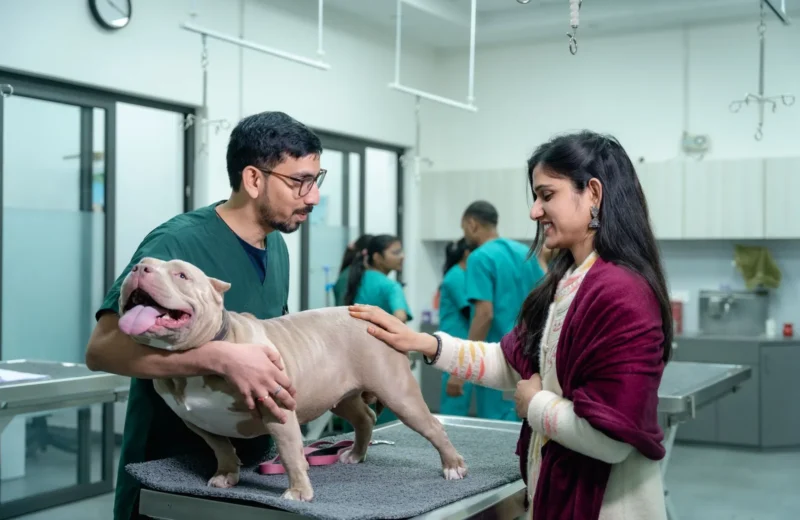
The Heathrow Animal Reception Centre is where your pet goes after the plane doors open, not where you meet it. Staff drive the crate off the aircraft, kennel the animal, check the paperwork against the Pet Travel Scheme, then release it to your nominated UK agent for customs clearance. City of London publishes an average of two to four hours from landing to collection.
Introduction: the last two hours are their own stage
Malaysian owners plan the vet work in detail and then treat landing as the finish line. It is not. Arrival at Heathrow is a separate process with its own facility, its own inspection, its own fees and its own failure modes, and it runs whether you are in the terminal or still in Kuala Lumpur.
Most of a Malaysia to United Kingdom pet file is planning. Microchip, rabies vaccine, tapeworm dose, health certificate, endorsement, flight booking. By the time the crate is loaded at KLIA, the owner has usually been working on it for months.
Then the plane lands, and a stage nobody researched begins. Your dog does not come out at a baggage carousel. It goes to a government-run animal facility on the airport perimeter, gets inspected, and is released only once someone has cleared it through customs on your behalf.
This piece walks that stage in order for owners flying a pet out of Kuala Lumpur. Our Malaysia to UK pet relocation service arranges the UK-side agent before the crate leaves Malaysia, because that appointment is what actually ends the wait. The video below is Defra’s own pet travel guidance.
What is the Heathrow Animal Reception Centre?
The Heathrow Animal Reception Centre is a Border Control Post run by the City of London Corporation, not by the airport or the airline. It has served Heathrow since 1977 and is the only border post there licensed for every animal species. It is a checkpoint and a boarding facility, not a quarantine kennel.
The name confuses people, so start with what it is not. It is not quarantine. A pet that meets the Pet Travel Scheme goes home the same day. It is also not run by your airline, which is why the airline cannot tell you when your dog will be released.
The City of London Corporation describes the facility as a Live Animal Border Control Post and a Travellers’ Point of Entry. Its stated annual volume is roughly 22,000 dogs and cats, 400 horses, 100,000 reptiles, 1,000 birds and 28 million fish.
- It is a border post. Compliance with the scheme is decided here, not at the check-in counter in Kuala Lumpur.
- It is a short-stay kennel. Your pet gets its own kennel with water, food and bedding while the file is checked.
- It is not a customs broker. Clearance is your agent’s job, and the pet waits until that is done.
That third point surprises Malaysian owners most. Set against the 30-day Singapore quarantine that Malaysian pets face, a few hours at Heathrow sounds like nothing. It still does not happen by itself. Somebody has to file the customs entry first.
Not sure who clears your pet on the UK side?
We appoint the UK agent before the crate leaves Malaysia, so nothing waits on a phone call at 6am. See how pet export from Malaysia works →
Step by step: landing to collection at HARC
Six things happen in order: HARC collects the crate from the aircraft, drives it to the facility in a climate-controlled van, kennels the pet, checks the paperwork against the Pet Travel Scheme, contacts your nominated UK agent for customs clearance, then releases the pet to you on production of ID and the air waybill.
- Collection from the aircraft. HARC staff meet the flight and move the crate in one of their own climate-controlled vehicles. This is a charged service, not something the airline absorbs.
- Kennelling. The pet is released into its own kennel with fresh water, food and a bedding area. Cats get a litter tray and dogs get access to an outdoor run.
- Paperwork inspection. The travel document, microchip, rabies record and (for dogs) tapeworm entry are checked against the scheme.
- Compliance decision. Non-commercial movements are checked by HARC staff; commercial shipments are checked by the Animal and Plant Health Agency.
- Agent contacted. Once compliance is cleared, HARC contacts your nominated UK agent so customs clearance can be filed.
- Release. You collect at the facility, which has free customer parking, bringing photographic ID, the air waybill and a lead and collar.
Notice that steps five and six are the only ones you influence on the day. Everything before them runs on decisions already locked in Malaysia. The single most common cause of a slow morning is that the agent was appointed late, or not at all.
What does the Heathrow Animal Reception Centre charge?
City of London publishes HARC’s handling fees openly. Aircraft collection is £104. Boarding is £213 if your paperwork was pre-checked and £293 if it was not, with £55 for each additional pet. A paperwork query adds a £99 administrative fee on top.
These are HARC’s own charges only. Airline freight, the crate, Malaysian vet work, endorsement and the UK customs agent all sit outside them, which is why the quoted total from any shipper looks much larger.
HARC Published Handling Fees, August 2026
| Service | Fee | When it applies |
|---|---|---|
| Collection from the aircraft | £104 | Every pet handled at the facility |
| Boarding, paperwork pre-checked | £213 | Your agent used the pre-checking service |
| Boarding, no pre-check | £293 | Paperwork arrives unseen |
| Each additional pet | £55 | Second and subsequent animals |
| Section 2 administrative fee | £99 | HARC must contact your vet for clarification |
Source: City of London Corporation, HARC fee and Pet Travel Scheme pages, read 12 August 2026. Fees are set by the Corporation and change; confirm current figures before budgeting.
The £80 gap between the two boarding rates is the interesting number. Pre-checking is a service your agent requests, so the cheaper rate is available on almost every Malaysian file, and losing it is an avoidable choice rather than bad luck.
Who checks the paperwork, HARC or APHA?
It depends on how the movement is classified. HARC staff check non-commercial Pet Travel Scheme arrivals themselves. Commercial shipments are checked by the Animal and Plant Health Agency instead, which is a different queue, a different regime and usually a different timeline.
Malaysian owners rarely realise their move might be commercial. The scheme’s non-commercial test is narrow: the owner or a designated person travels within five days of the pet, the consignment holds no more than five animals, and a signed non-commercial declaration accompanies the entry document.
Miss any of those and the movement becomes a trade import under the Balai rules, even though it is the same family dog. Selling or rehoming the animal, or a pet flying more than five days apart from its owner, both trip the test.
Sending the dog ahead so the family can settle in first is the most common way a straightforward move becomes a commercial import.
Decide the classification before you book flights, not after. It changes the certificate, the checker and the paperwork chain. Our note on why UK-bound pets fly as cargo and never as baggage covers the booking side of the same decision.
How long does it take from landing to collection?
City of London states that pets are ready to collect within two to four hours of arrival on average. That average assumes clean paperwork and an agent already appointed. Any query to your Malaysian vet extends the day, because the answer has to come back across a seven-hour time difference.
The table below maps a clean arrival against the published average. Treat it as an illustrative sequence, not a promise, because ramp congestion and flight bunching move every line.
Illustrative Arrival Timeline For A Clean Malaysian File
| Time from landing | What is happening | Who controls it |
|---|---|---|
| 0:00 | Aircraft on stand, hold opened | Airline and ground handler |
| 0:20 – 0:50 | Crate collected, driven to HARC | HARC |
| 0:50 – 1:15 | Kennelled, water and bedding | HARC |
| 1:15 – 2:00 | Paperwork and microchip check | HARC, or APHA if commercial |
| 2:00 – 3:00 | Agent contacted, customs entry filed | Your UK agent |
| 2:00 – 4:00 | Release and collection | You, with ID and air waybill |
Illustrative sequence modelled on the two to four hour collection average published by the City of London Corporation, read 12 August 2026. Individual arrivals vary with flight timing, ramp congestion and customs.
The only row with your name on it is the customs entry. That is the row worth managing, and it is managed by appointing the agent early rather than by arriving at the facility early.
Want the whole UK arrival handled end to end?
We book the flight, brief HARC’s pre-check and appoint the customs agent as one job. See our Malaysia to UK pet transport service →
The two things that hold Malaysian files at HARC
Two problems account for most Malaysian delays. The first is the rabies vaccine product name being left off the certificate, which HARC names as its most common paperwork fault. The second is the Nipah certification that Peninsular Malaysia alone must supply.
HARC publishes its own list of common faults, and the vaccine entry sits at the top. The vet must record the manufacturer, the product name, the batch number and the validity dates. Writing only the manufacturer holds the pet until the vet confirms the rest, which triggers the £99 fee.
The second is corridor-specific. Health certification from the Malaysian veterinary authorities must confirm three things for pets leaving the peninsula:
- No pig contact. The animal had no contact with pigs for at least the 60 days before export.
- No Nipah on the holding. No case of Nipah disease was confirmed on the holding during the past 60 days.
- A negative Nipah test. Sampled within ten days of export, tested at an approved laboratory.
Ten days is not much room once you count laboratory turnaround and a public holiday. We cover the biology and the timing in our piece on why UK pet exports ask about pig contact, and the certificate itself in the export health certificate for UK-bound pets.
Dogs carry a third exposure. The tapeworm dose must be given no less than 24 hours and no more than 120 hours before entry, and HARC counts those hours in UK time. Our guide to the tapeworm treatment window for dogs entering the UK works through the arithmetic.
What a paperwork error costs, by severity
HARC sorts non-compliance into three sections. Section 1 is a minor administrative slip and costs nothing. Section 2 requires HARC to contact the issuing vet and carries a £99 fee. Section 3 is serious and can mean re-treatment, quarantine or re-export at the owner’s cost.
The bars below show the minimum added cost at each severity. Section 3 has no published ceiling because the outcome depends on what went wrong.
Minimum Added Cost By HARC Non-Compliance Section, August 2026
| Section | Minimum added cost | Consequence for the pet |
|---|---|---|
| Section 1 |
£0 |
Released as normal, no further action |
| Section 2 |
£99 |
Held while HARC contacts the issuing vet |
| Section 3 |
£99 plus re-treatment, boarding and further charges |
Possible quarantine or re-export to Malaysia |
Source: City of London Corporation, HARC Pet Travel Scheme page, read 12 August 2026. Bar widths are proportional to the minimum published cost; Section 3 has no published ceiling.
An invalid tapeworm dose is the textbook Section 3. HARC re-treats the dog on site, which adds the treatment cost and another 24-hour boarding fee, so a missed window turns a same-day collection into a next-day one.
Which airlines do not route pets through HARC?
Most pets arriving at Heathrow are handled at HARC, but City of London names seven carriers whose animals are handled elsewhere: IAG Cargo, Air India, Lufthansa, El Al, Oman Air, Turkish Airlines and Austrian Airlines. Your carrier decides which building you drive to.
This matters on the Malaysia corridor because several plausible routings sit on that list. Grouping them against how a Kuala Lumpur departure usually reaches London makes the point clearly.
Carrier Handling At Heathrow Grouped By Relevance To A Kuala Lumpur Departure
| Group | Carriers named | What it means for a KL file |
|---|---|---|
| Handled away from HARC | IAG Cargo, Lufthansa, Turkish Airlines, Austrian Airlines | Common one-stop options from Kuala Lumpur; confirm the collection address early |
| Air India, El Al, Oman Air | Less usual on this corridor, same handling difference applies | |
| Handled at HARC | All other carriers arriving at Heathrow | Fees, timeline and collection process in this article apply directly |
Source: City of London Corporation, HARC importing page, updated 9 August 2026. Carrier arrangements change; confirm with your shipper at booking.
So the carrier you pick also picks your collection address. Airline choice on this corridor already turns on crate size and hold conditions, which our guide to airlines carrying pets to and from Malaysia covers in detail.
What to bring on collection day
Three items: photographic identification, the air waybill, and a lead and collar for a dog. HARC has free customer parking. Pack the same lead on the outside of the crate before departure so there is a spare if your copy is in a suitcase.
HARC also asks that a pet information sheet is completed for each animal and attached to the travel container, and recommends securing two portions of the pet’s usual food to the outside of the crate. Any food travelling with the animal must be commercially packaged and sealed.
Crate preparation belongs to the departure end, which is why our note on IATA crate sizing for dogs is worth reading before the box is bought rather than after.
Conclusion: the arrival is decided in Malaysia
Nothing you do at Heathrow speeds the process up. The variables that decide a two-hour morning are all set earlier: pre-checked paperwork, a correctly worded vaccine entry, a Nipah certificate drawn inside ten days, a tapeworm dose timed against landing, and a UK agent already appointed.
Malaysia’s listed status is what makes this corridor workable at all. HARC sets out the Malaysian requirements inside its guidance for listed countries rather than its unlisted section, which is consistent with Malaysia not needing the rabies blood test and three-month wait that unlisted origins face. We set the position out in full in our explainer on whether Malaysia is a listed country for UK pet travel.
Check the current entry on GOV.UK’s pet travel guidance before you commit to dates, because listings are reviewed and the requirements move with them. Everything in this article describes the rules as published in August 2026.
Beyond that, treat arrival as the last item on the departure checklist rather than the first item of a new one. Every delay described above traces back to a decision made weeks earlier at a Malaysian vet’s desk or a shipper’s booking screen. That is where My Pet Mover does the work.
Moving your pet from Malaysia to the UK?
We handle the certificate timing, the Nipah window, the HARC pre-check and the UK customs agent as one file, so collection day is just a drive to Heathrow.
Frequently Asked Questions
1. Is the Heathrow Animal Reception Centre a quarantine facility?
No. It is a Border Control Post and short-stay boarding facility run by the City of London Corporation. A pet that complies with the Pet Travel Scheme is released the same day, typically within two to four hours. Quarantine only applies where the file fails and the authorities direct it.
2. Can I meet my pet at the arrivals hall instead?
No. Pets flying to Heathrow travel as manifest cargo in the hold, so they never reach the passenger arrivals hall. Collection happens at the animal facility, and only after customs clearance has been filed by your nominated UK agent.
3. How much does HARC charge to handle my pet?
City of London publishes £104 for collection from the aircraft, plus boarding at £213 with a paperwork pre-check or £293 without, and £55 for each additional pet. A Section 2 paperwork query adds £99. These were the published figures on 12 August 2026; confirm before budgeting.
4. Do I need a UK agent if I am flying with my pet?
Yes. City of London states that you must appoint a UK customs agent whether or not you use a pet shipper, because the pet has to be cleared through customs before release. Travelling on the same flight does not remove that step.
5. What extra certificate does a pet from Peninsular Malaysia need?
Health certification from the Malaysian veterinary authorities confirming no pig contact for at least 60 days, no confirmed Nipah case on the holding in the past 60 days, and a negative Nipah antibody test from a blood sample taken within ten days of export. Confirm the current wording with DVS before you book.
6. What happens if my dog’s tapeworm treatment is invalid on arrival?
HARC re-treats the dog on site. That is treated as a serious non-compliance, so it adds the re-treatment cost and a further 24-hour boarding fee, which usually turns a same-day collection into a next-day one.