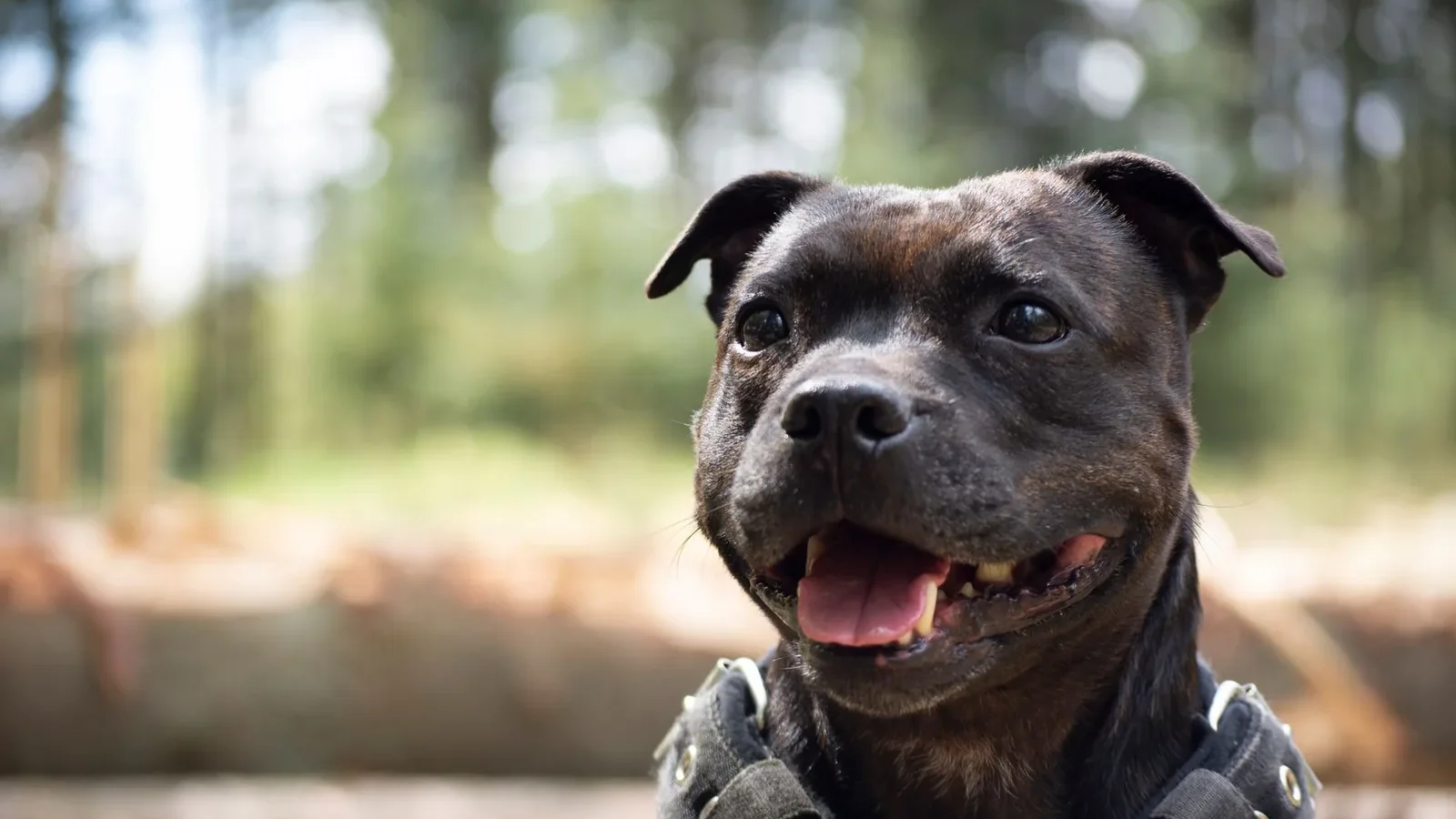
The Staffordshire Bull Terrier is not a banned type in Great Britain, so a Staffordshire Bull Terrier UK import is legal on paper. The risk sits elsewhere. British officers judge a dog by what it looks like, not by its pedigree, and the owner carries the burden of proof. Malaysia bans the same breed on import, so this corridor runs one way.
Introduction: the breed that only travels one way
A Staffordshire Bull Terrier can legally move from Malaysia to Great Britain. The same dog cannot legally be imported back into Malaysia, because Malaysia’s veterinary authority names the breed on its banned import list. Owners rarely learn this until they try to come home.
Most families who ask about this breed worry about the wrong end of the journey. They have read that Britain bans certain dogs, seen a Staffie called a bull breed, and assumed the UK is the obstacle.
It usually is not.
The obstacle is that Malaysia and Britain disagree about this dog. Britain treats the Staffordshire Bull Terrier as an ordinary pet; Malaysia’s import rules group it with the pit bull. The outbound leg is straightforward, the return leg is closed, and nobody mentions that until the posting ends.
This piece covers what Britain actually bans, how an officer decides a dog is “of type”, what the health file needs, and what happens to the same dog in reverse. It is written for owners on the Malaysia to UK pet transport route. The video below sets out the UK’s health requirements first.
Is a Staffordshire Bull Terrier banned in Great Britain?
No. GOV.UK lists five banned types in the UK — the Pit Bull Terrier, Japanese Tosa, Dogo Argentino, Fila Brasileiro and XL Bully. The Staffordshire Bull Terrier is not among them. It is an ordinary, legally owned breed across England, Wales and Scotland.
The list on GOV.UK’s banned dogs page is short and closed. The breed is registered, shown and kept in ordinary British homes, and no permit or muzzle order attaches to it by name.
So the sentence that stops other moves dead — you cannot bring a banned breed into Great Britain unless it already holds a Certificate of Exemption — does not apply here. That sentence is what ends an XL Bully import to the UK. It does not touch a Staffie.
But the same page carries a second line that does:
Whether your dog is a banned type depends on what it looks like, rather than its breed or name.
That is the whole risk. The breed name protects nobody; the dog in front of the officer is the evidence.
Not sure which side of the line your dog falls on?
Send us clear side and front photos plus the height at the withers before you book anything. See how our pet export process starts →
How does Britain decide a dog is “of type”?
A trained Dog Legislation Officer compares the dog against a published conformation standard. Section 1 of the Dangerous Dogs Act 1991 reverses the burden of proof, so if an officer says the dog is a prohibited type, the owner has to prove in court that it is not.
Three mechanisms sit behind that, and all three matter before a Staffordshire Bull Terrier UK import goes on a plane.
- Section 1 works on type, not breed. The Act prohibits dogs “of the type known as” the pit bull terrier. A dog with no pit bull ancestry can still be caught.
- The burden of proof is reversed. Defra’s guidance for enforcers states plainly that it is the owner who must prove to the court that the dog is not of the prohibited type.
- The threshold is “substantial”, not “identical”. The same guidance says the dog need not fit the description perfectly — it needs enough characteristics present to be considered more pit bull than any other type.
Officers work from the American Dog Breeders Association conformation standard, published in the Pit Bull Gazette in 1977. It is a list of shapes and ratios: outline, head proportion, eye set, shoulder width, foreleg thickness, rib shape, tail carriage. What it leaves out is the part owners expect. Defra notes that the standard makes no mention of ears, colour, height or weight, so a pedigree certificate and a tape measure answer none of the questions being asked.
Which physical checkpoints decide a pit bull type call?
Every checkpoint in the assessment is a shape or a ratio. Not one is answered by a pedigree document, a microchip record or a DNA result, which is why owners who arrive armed with papers can still lose the argument.
What The Pit Bull Type Check Looks At
| Checkpoint | What the standard describes | Answered by papers? |
|---|---|---|
| Overall outline | Square from the side; shoulder height equals shoulder-to-hip length | No |
| Head shape | Wedge from side and top, rounded from the front | No |
| Head proportion | About two-thirds of shoulder width; 25% wider at the cheeks | No |
| Shoulders | Wider than the rib cage at the eighth rib | No |
| Forelegs | Heavy and solid, near twice the thickness of the hind legs below the hock | No |
| Rib cage | Deep, elliptical in cross-section, tapering — not barrel chested | No |
| Tail | Hangs like an old-fashioned pump handle, to about the hock | No |
| Ears, colour, height, weight | Not mentioned anywhere in the standard | Not assessed at all |
Source: Defra, Dangerous Dogs Law Guidance for Enforcers, Annex 2. Read 12 August 2026.
Read the last row twice. Height is not part of the pit bull assessment, so a compact dog is not automatically safe. Height is part of the XL Bully assessment, where Defra’s conformation standard sets a floor of 51cm at the withers for adult males and 48cm for females. A typical adult Staffie sits below both, so the XL Bully route is rarely the live question. The older pit bull criteria are.
Where does the Staffie sit against Britain’s five banned types?
Britain names five types and Malaysia names seven, and the lists only partly overlap. The Staffordshire Bull Terrier and the American Staffordshire Terrier sit on Malaysia’s banned import list but on neither British list. They are the only two breeds here where direction of travel changes the answer.
Britain’s Banned Types Against Malaysia’s Banned Imports
| Breed or type | Banned in GB? | Banned into Malaysia? | Blocked in both |
|---|---|---|---|
| Pit Bull Terrier | Yes | Yes | |
| Japanese Tosa | Yes | Yes | |
| Dogo Argentino | Yes | Yes | |
| Fila Brasileiro | Yes | Yes | |
| XL Bully | Yes | Not by that name | |
| American Staffordshire Terrier | Not named | Yes | |
| Staffordshire Bull Terrier | Not named | Yes |
Sources: GOV.UK banned dogs guidance; Malaysia DVS importation regulations for dogs and cats, revised 13 December 2013. Read 12 August 2026.
Malaysia’s import regulations for scheduled countries do not list the Staffordshire Bull Terrier separately. They fold it into the pit bull heading, which names the American Pit Bull, the American Pit Bull Terrier, the American Staffordshire Terrier and the Staffordshire Bull Terrier as one entry. Two very different British breeds sit inside one Malaysian line. Our guide to dog breeds banned or restricted in Malaysia covers the full list.
What does a Staffie need to enter Britain from Malaysia?
The same file as any other dog. Malaysia is a listed country for GB pet travel, so there is no rabies blood test and no three-month wait. Peninsular Malaysia adds one extra document — a Nipah certificate from the government veterinary service.
How to build the UK entry file for a dog leaving Malaysia
The order matters more than the paperwork, because one step done out of sequence invalidates everything after it. The short version of Malaysia’s listed-country status for UK pet travel is that you skip the blood test, not the sequence.
- Microchip first. The chip must go in before the rabies vaccination, not after. This one ordering rule is the most common reason a file restarts — see the UK microchip and rabies order rule.
- Vaccinate against rabies. GOV.UK requires at least 21 full days between the first vaccination and arrival in Great Britain.
- Book the Nipah blood test. For Peninsular Malaysia only, the sample must be taken within 10 days of departure and tested by an approved laboratory.
- Get the Great Britain pet health certificate. This is the travel document for dogs arriving from Malaysia; a pet passport is not an option.
- Treat for tapeworm. A vet must treat the dog no less than 24 hours and no more than 5 days before arrival in Great Britain.
The breed adds nothing to that list. There is no extra form and no breed clearance for a Staffordshire Bull Terrier UK import. What it adds is a judgement risk on arrival, which no certificate settles.
Want the sequence handled for you?
We book the vet appointments in order and hold the Nipah test to the departure date. Read how UK export health certificates work →
When does each step have to happen?
Two windows open 60 days out, one closes 21 days before arrival, and two are counted in single-digit days. The Nipah blood sample and the tapeworm treatment sit in the tightest windows, and both are near the end.
UK Entry Windows, Counted Back From Arrival
| When | Step | The rule as published |
|---|---|---|
| Any time before | Microchip | Must be fitted before the rabies vaccination |
| 60 days before departure | Pig contact window opens | No contact with pigs; no stay on a Nipah-affected holding |
| 21+ days before arrival | Rabies vaccination | At least 21 full days after the first vaccination |
| Within 10 days of departure | Nipah blood sample | Sample taken no more than 10 days before you leave |
| Before departure | GB pet health certificate | Required for dogs arriving from Malaysia |
| 1 to 5 days before arrival | Tapeworm treatment | No less than 24 hours and no more than 5 days before arrival |
| On arrival | Documentary and type check | Up to 4 months quarantine if the rules were not followed |
Source: GOV.UK guidance on bringing a pet dog, cat or ferret to Great Britain. Read 12 August 2026.
The 10-day Nipah window decides the booking. It cannot be pulled forward to suit a cheaper flight, and a delay can push a sample out of date. That certificate is also why UK pet exports ask about pig contact.
Why will Malaysia not let the same dog back in?
Because Malaysia’s veterinary import regulations name the Staffordshire Bull Terrier inside the pit bull entry on the banned breed list. A banned breed cannot receive an import permit, and without a permit there is no legal route in — regardless of where the dog previously lived.
This is the part almost nobody writes about, and it is the part that hurts.
Malaysia sorts imports into scheduled and non-scheduled countries, and the United Kingdom sits in the easier scheduled group. None of that helps here, because the breed check happens before the country check. The pit bull entry on the banned list expressly names the Staffordshire Bull Terrier.
Restricted breeds such as the Rottweiler or the German Shepherd can be brought in with written approval, a pedigree certificate and a premises inspection. Banned breeds have no equivalent path — no application, no bond, no conditional permit. That is why the usual advice on how to get a MAQIS import permit for your pet stops short for this breed.
The consequence for an expatriate family is blunt. A Staffie that leaves Kuala Lumpur for London is not coming back on a Malaysian posting, and a Staffie bought in Britain cannot join you when you move here. If you expect to return, decide before the dog boards.
Four owner situations and how each one ends
Three of the four situations we see most often end well. The one that does not is the family planning to return to Malaysia, and it is the only one where a rule rather than an assessment fixes the outcome.
Four Staffie Situations, Modelled
| Situation | What decides it | Realistic outcome | Next step |
|---|---|---|---|
| Registered Staffie, KL to London, one-way | Appearance on arrival | Proceeds normally | Build the health file in sequence |
| Staffie cross, parentage unknown | Conformation assessment | Usually fine, occasionally disputed | Get an expert opinion before booking |
| Family expects to return to Malaysia | Malaysia’s banned breed list | Return leg closed | Decide before the dog leaves |
| Dog already assessed as a type in GB | Certificate of Exemption terms | Movement heavily conditioned | Ask the Index of Exempted Dogs in writing |
Illustrative planning model built on published GOV.UK and Malaysia DVS rules as at August 2026. Not a substitute for a case assessment.
The second row is where most of our conversations happen. A rescue with unknown parentage and a broad head is not a legal problem in Britain, but it is an unpredictable one — and unpredictability is expensive once a dog is in the air. Compare the fixed 30-day rule facing Malaysian pets entering Singapore quarantine, where you know the number in advance.
Conclusion: check the dog, then the calendar
Britain welcomes the Staffordshire Bull Terrier and Malaysia will not take it back. Check the dog’s appearance against the type standard, settle whether the family intends to return, then start booking vets and flights.
Rules here change, and they change at both ends. The figures reflect GOV.UK guidance read on 12 August 2026 and Malaysia’s DVS import regulations revised in December 2013, with country lists updated in December 2025. Confirm the current position with Defra and MAQIS before you commit.
Start at My Pet Mover if you want the breed question settled before the quotes, or read the wider pet import rules for Malaysia if the move runs the other way.
Frequently Asked Questions
1. Can I take my Staffordshire Bull Terrier from Malaysia to the UK?
Yes. The Staffordshire Bull Terrier is not one of Great Britain’s five banned types, so no exemption certificate is needed. The dog travels on the standard health file — microchip, rabies vaccination, tapeworm treatment and a Great Britain pet health certificate, plus a Nipah certificate from Peninsular Malaysia.
2. Will a pedigree certificate protect my dog at the border?
Not on its own. GOV.UK states that whether a dog is a banned type depends on what it looks like, rather than its breed or name. The assessment is a physical comparison against a conformation standard that never mentions colour, ears, height or weight.
3. Does my Staffie need a rabies blood test for the UK?
No. Malaysia is a listed country on GOV.UK’s pet travel table, so the rabies antibody test and three-month wait do not apply. You still need at least 21 full days between the first rabies vaccination and arrival.
4. Why is a Staffordshire Bull Terrier banned in Malaysia but not in Britain?
Because the two countries define the group differently. Malaysia’s veterinary import regulations treat the Staffordshire Bull Terrier as an alias inside the pit bull entry on the banned breed list. Britain treats the pit bull as a distinct type and never names the Staffie.
5. What happens if a British officer thinks my dog is a prohibited type?
The dog can be seized while the matter goes to court, and the burden of proof falls on the owner to show the dog is not of that type. Penalties include an unlimited fine, up to six months in prison and destruction of the dog. An expert opinion before travel is worth far more than one afterwards.
Moving a bull breed and want a straight answer first?
Tell us the breed, the destination and whether you expect to return to Malaysia. We check both ends against the authorities’ own rules, tell you honestly what is possible, then open the file.