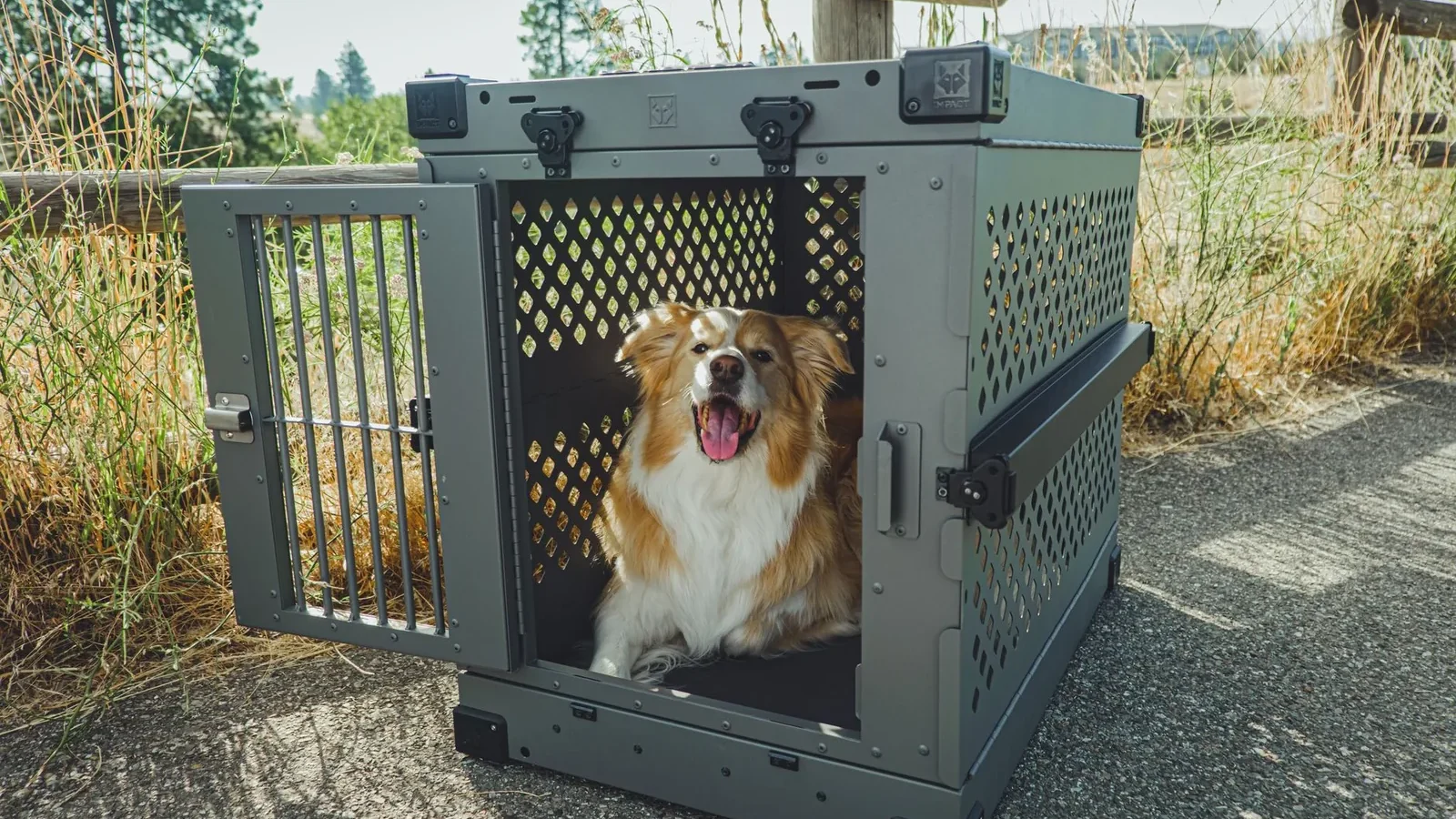
Two pets share one crate only in narrow cases: two adults of comparable size, each 14 kg or under, already used to living together. Everything above that flies separately. Even when IATA permits it, the destination country and the airline can each say no. And a shared crate saves about a quarter of the space, not half.
Introduction: why owners ask this in the first place
Owners ask whether two pets share one crate for two reasons: they think it will comfort the animals, and they think it will cost less. The rules allow it in a narrow band. The arithmetic behind the cost saving is smaller than most people expect, and the approval chain is longer.
Almost every family with two pets asks this, and for the same two reasons. The animals sleep in the same bed at home, so separating them for a long-haul flight feels cruel. And two crates in the hold sounds like double the bill.
Both instincts are reasonable. Neither survives contact with the actual rulebook without some trimming.
What most articles miss is the part after the IATA rule. IATA sets the floor. Your destination’s national regulator and the airline you booked can both raise it, and the last word belongs to whoever is standing at the acceptance counter. My Pet Mover handles this decision weekly across our international pet transport routes, and the crate question is settled by the destination far more often than by the crate itself.
The video below walks through how a pet is measured for an airline crate — the same measurements that decide whether a pair can fit in one.
What the IATA rule actually says
IATA allows a maximum of two adult animals of comparable size, each up to 14 kg, that are compatible and used to cohabiting, in one container. Anything over 14 kg must be crated individually. Puppies and kittens have a separate, slightly wider allowance.
Container Requirement 1 of the IATA Live Animals Regulations covers domestic dogs and cats. It holds two separate permissions, and mixing them up causes most of the confusion online.
The adult rule is the tighter of the two. IATA states that a maximum of two adult animals of comparable size up to 14 kg each may be shipped in the same primary enclosure, provided they are compatible in size and used to cohabiting. Animals over 14 kg must be crated individually — no exceptions, no larger crate workaround.
The young-animal rule is separate. Weaned puppies or kittens may travel together if they are under six months, weigh no more than 14 kg each, number no more than three per container, and are used to cohabiting. Nothing under eight weeks flies at all, which is where deciding how young is too young to export a puppy or kitten starts.
- “Comparable size” is doing real work. A 4 kg cat and a 13 kg terrier are both under the ceiling and still fail this test.
- “Used to cohabiting” is not the same as “gets along”. Two dogs that meet at the park do not qualify. Two that share a home do.
One more line matters more than the headline permission. IATA notes that certain national regulations require cats and dogs to be crated individually regardless, and that sentence overrides the rule on a large share of real bookings.
The four rule layers that outrank IATA
Four layers sit between the IATA text and your pets on an aircraft: the IATA standard, the destination country’s own regulation, the airline’s published variation, and the acceptance officer at the counter. Any layer can forbid sharing. None can permit what the layer above it has already refused.
Who Can Say Yes, Who Can Say No, and When You Find Out
| Decision layer | Can permit? | Can forbid? | When you find out |
|---|---|---|---|
| IATA Live Animals Regulations | Yes — sets the ceiling | Yes | Immediately, from the published standard |
| Destination national regulation | No — cannot widen IATA | Yes — commonly does | At import-permit stage |
| Airline operator variation | No | Yes — often does | At booking, if you ask the right question |
| Acceptance staff at the counter | No | Yes — final say | On flight day, too late to fix |
Source: My Pet Mover, compiled from IATA Container Requirement 1 and export practice, 2026. Licence.
The right-hand column is the whole risk: the layers that most often say no are also the ones that answer late. A European move shows the better pattern. The paperwork chain in a Malaysia to Germany pet relocation settles the crate question weeks before anyone reaches the airport.
The asymmetry is the point. Nobody downstream can grant permission, and everybody downstream can withdraw it. So the question to ask is never “is this allowed?” but “which of these four has already ruled on my route?”
Does one crate actually cost less than two?
A shared crate saves about a quarter of the volumetric space, not half. Air cargo charges on the larger of actual and volumetric weight, and because a shared crate is three shoulder-widths instead of four, the saving lands near 25% before any handling and paperwork costs are counted.
Pet flights are priced on volumetric weight: the crate’s length by width by height in centimetres, divided by the standard air cargo factor of 6,000. The animal’s own weight rarely drives the bill. The box does.
Volumetric Weight: Two Separate Crates vs One Shared Crate
| Pair | Two crates | One shared crate | Difference |
|---|---|---|---|
| Two cats, 5 kg each | 16.2 kg | 12.2 kg | 4.0 kg lighter |
| Two small dogs, 9 kg each | 34.3 kg | 25.7 kg | 8.6 kg lighter |
| Two beagles, 13 kg each | 56.3 kg | 42.2 kg | 14.1 kg lighter |
| Two dogs, 16 kg each | Two crates only | Not permitted | No saving available |
Source: My Pet Mover, modelled from IATA sizing and the 6000 volumetric divisor, 2026. Licence.
Two crates take four shoulder-widths of space. One shared crate takes three. That ratio is why the saving is a quarter, on every pair, at every size.
A quarter is real money on a long-haul lane. It is not the halving owners usually budget for, and it carries one point of failure: if the shared crate is refused, both animals are stuck. Carrier policy varies too, so we start with which airlines carry pets to and from Malaysia before pricing anything.
When sharing is allowed but still wrong
Clearing the rules is not the same as making a good decision. Animals that are calm at home can behave differently under engine noise, pressure changes and hours of confinement, and a shared crate removes the one thing a frightened animal wants most, which is somewhere to retreat to.
The regulations are written around size and compatibility, not around what a stressed animal does at 3 a.m. over the Indian Ocean. Three situations come up repeatedly where a pair qualifies and we still recommend two crates.
- One animal is markedly more anxious than the other. The calmer animal absorbs the panting, pacing and vocalising for the whole flight, and neither settles.
- The route has a long layover. Hours on a warm apron with two animals in one box concentrates heat and waste far more than a single-occupancy crate.
- One animal has a medical condition. A pair sharing a crate cannot be observed or handled separately, which matters for anything cardiac or respiratory — the same logic behind flying a Cavalier King Charles with heart risks.
There is a quieter operational reason too. If one animal soils the crate early in a twelve-hour sector, both sit in it. With two crates, that stays one animal’s problem.
Owners often raise the opposite argument, that separating bonded pets is distressing. In our experience the bond helps through proximity rather than contact. Two crates loaded side by side give each animal the other’s scent and sound without the physical risk.
Moving two pets on the same flight?
We can book them adjacent in the hold on most lanes, which gets the comfort without the crate risk. Check the routes we fly pets on →
What we usually book out of KLIA instead
For most pairs leaving Malaysia we book two individually sized crates on the same flight, loaded adjacent where the airline allows it. It clears every rule layer, removes the flight-day rejection risk, and gives up roughly a quarter of the volumetric saving in exchange.
The exception is genuine littermates under six months, where a shared crate is both permitted and sensible and the destination has confirmed it in writing. For everything else, the default is two crates.
- Measure both animals separately. Four figures each: nose to tail base, ground to elbow, widest shoulder point, and standing height to the head or ear tip.
- Confirm the destination’s rule in writing. At import-permit stage, not at the airport. This is the layer that most often decides the question.
- Ask the airline for its container variation. Carriers publish their own departures from the IATA standard. A booking agent should check these before quoting.
- Book both animals on one air waybill. Same flight, same handling, adjacent loading. That is the practical version of keeping them together.
- Crate-train each animal in its own crate. Start weeks out, not days. Cats need the most lead time, as we cover in crate training your cat before an overseas move.
That sequence sounds slower than buying one big crate. It is faster, because nothing in it can be reversed by a stranger on flight morning.
Conclusion
Two pets share one crate only when both are 14 kg or under, comparable in size, already cohabiting, and cleared by the destination and the airline. Litters under six months get a wider allowance. For most adult pairs leaving Malaysia, two crates on one flight is the better booking.
The shared crate is a narrower option than it sounds. The weight ceiling removes most dogs, the width formula removes several routes, and the destination and airline remove more. What survives is a small, well-matched, already-cohabiting pair on a lane where everyone has agreed in writing.
If your pets sit in that band, sharing is fine and we will book it. If not, two crates is not a compromise. It is the arrangement that most reliably gets both animals off the aircraft as they boarded.
Flying two pets out of Malaysia?
Send us both weights, both shoulder measurements, the ages and the destination. We will tell you whether a shared crate clears every layer on your route, what each option costs, and how the two animals get loaded on the day.
Frequently asked questions
1. Can two dogs share one crate on a flight?
Only if both are adults of similar size weighing 14 kg or less each, already used to living together, and the destination and airline both allow it. If either dog is over 14 kg, each needs its own crate. That ceiling rules out most dog pairs leaving Malaysia.
2. Can a dog and a cat travel in the same crate?
In practice, no. Handling rules keep dog and cat containers apart, and the air-transport limit of one adult animal per enclosure closes the door for grown pets. Carriers routinely refuse a mixed pair at booking even where a rule allows it.
3. Can two puppies fly in the same crate from Malaysia?
Yes, within limits. Weaned puppies or kittens aged eight weeks to six months, weighing no more than 14 kg each and used to cohabiting, may share one container, up to three. Some destinations cut this to two, and nothing under eight weeks flies.
4. Is it cheaper to put two pets in one crate?
Somewhat, but less than most owners assume. A shared crate is three shoulder-widths wide against four for two separate crates, so the volumetric saving is around 25%. Handling, documentation and veterinary costs stay the same, making the total saving smaller again.
5. What happens if the airline rejects a shared crate at check-in?
Both animals miss the flight, not one. Acceptance staff have the final say and can refuse a container they judge too crowded or poorly ventilated. Replacing a crate at the airport is rarely possible, so you rebook and redo the health-certificate timing.
6. Do bonded pets actually travel better together?
They travel better near each other, which is not quite the same thing. Two crates loaded side by side give both animals familiar scent and sound while keeping separate space, ventilation and handling. That usually beats a shared crate for anxious fliers.