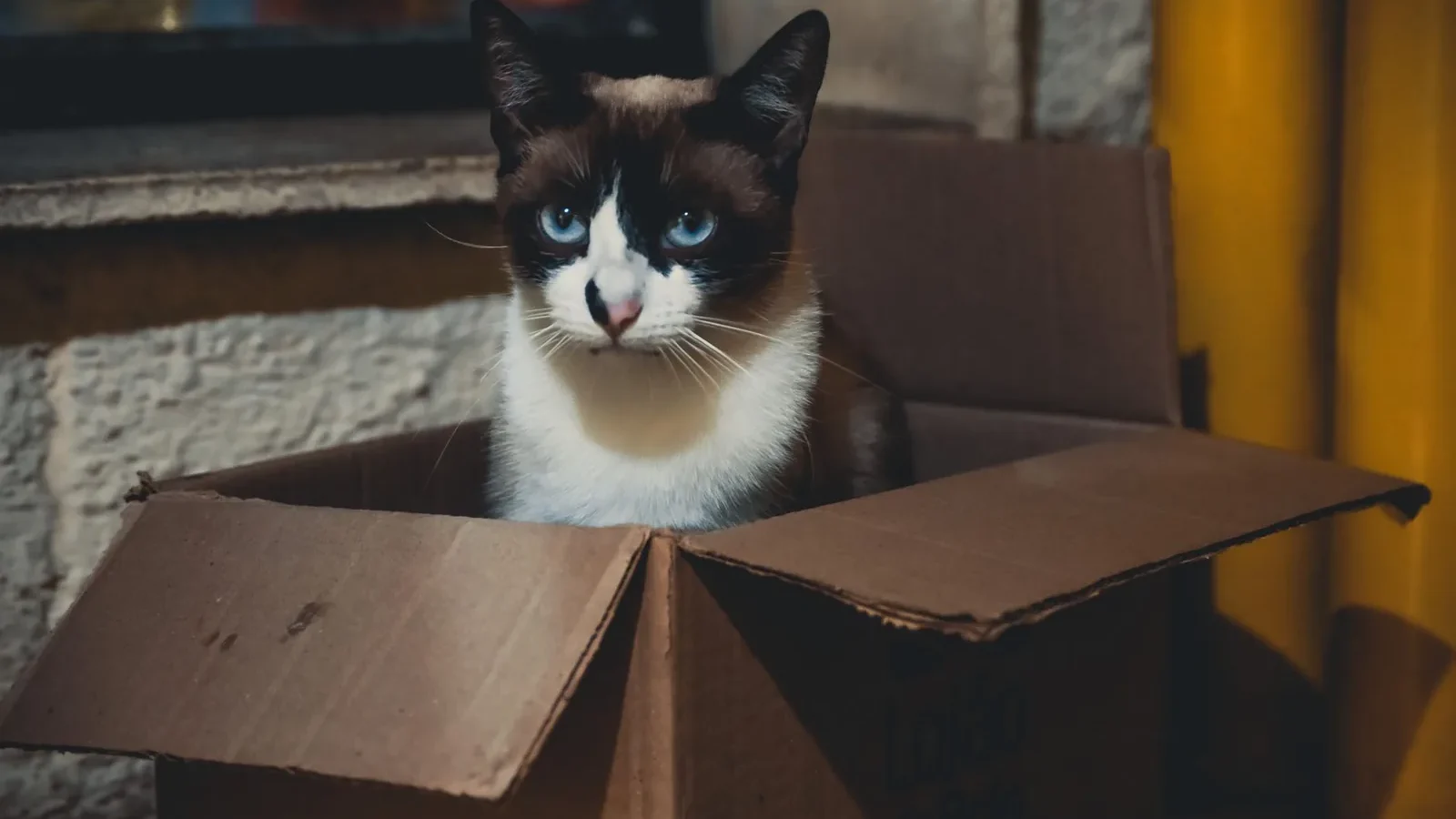
Crate training cat for flight only works if you train in the box the cat will actually fly in. That box is a rigid IATA-standard container with a metal-hinged door, ventilation on all four sides and a water bowl bolted inside — nothing like the soft carrier in your store room. Buy it first, put it in the living room, and give yourself eight weeks. A cat that walks in by itself is a cat that clears check-in calmly; a cat posted into a strange box on departure morning is not.
Introduction: most owners train in the wrong box
Nearly every cat carrier guide online is written for a twenty-minute drive to the vet. An international move is a different exercise. The container is bigger, harder and louder, the confinement lasts hours rather than minutes, and the box has to be bought months ahead of the flight.
Owners planning a move overseas usually do the training part in good faith. They dig out the carrier the cat already knows, leave the door open, drop in a few treats, and count it as preparation.
Then the crate arrives from the supplier, and it is a different object entirely. Rigid plastic. A metal-hinged door. Bolts down both sides. A water bowl fixed to the inside of the door. The cat has never seen it, and there are ten days left.
This piece takes the crate-first view rather than the carrier-first view, because on an international pet export out of Malaysia the container is regulated equipment, not a shopping choice. The short guide below covers the basics of confinement before we get into what changes for a flight.
Why crate training cat for flight is a different job
Vet-carrier training teaches a cat to tolerate a short, familiar trip. Flight preparation asks for something harder: settling alone in an unfamiliar rigid box, in noise, for several hours, with no owner in sight and no option to open the door.
Three things change once the trip involves an aircraft.
- The container is prescribed, not chosen. Airlines accept live animals against the IATA Live Animals Regulations. A carrier that fails the standard is refused at acceptance, and no amount of training rescues it.
- The confinement is long and unaccompanied. A vet trip is fifteen minutes with a familiar human. A sector to Europe is many hours in a hold, preceded by check-in and followed by clearance.
- The remedy owners reach for is off the table. IATA states plainly that tranquillisation of dogs and cats is not recommended, so the calm has to be built in advance — the reasoning is set out in our piece on why vets advise against sedating pets for flights.
That last point reframes everything. Crate training cat for flight is not a comfort measure here. With sedation off the table, it is the only lever you have.
Not sure yet whether your cat flies in the hold or under the seat?
The answer changes which container you buy, and therefore what you train in. Compare cabin, cargo and excess baggage first →
Buy the flight crate first, then train in it
The order matters more than the technique. Buy the compliant crate at the start of the preparation window, not at the end, so every week of crate training cat for flight happens inside the object the cat will actually travel in.
The gap between an everyday carrier and an air-cargo container is wider than most owners picture, and every difference is something the cat has to get used to.
Everyday Cat Carrier Versus An Air-Cargo Crate, Feature By Feature
| Feature | Typical everyday carrier | Air-cargo crate standard | Training consequence |
|---|---|---|---|
| Shell | Soft fabric or light plastic | Rigid plastic, fibreglass, metal or plywood | Harder, colder and noisier underfoot |
| Assembly | Zip or plastic clips | Metal nuts and bolts, clips alone not accepted | Assemble once, then leave it assembled |
| Door | Zip or light mesh flap | Full-end door with metal hinges and locking pins | Closing it makes a sound the cat must learn |
| Ventilation | Openings on two sides is common | All four sides, at least 16% of side area | Far less visual hiding, so bedding matters |
| Mesh openings | Unregulated | Maximum 19 mm x 19 mm for cats, nose and paw proof | A dog-spec crate can fail on this alone |
| Water | None | Open bowl fixed inside, fillable from outside | Cat must accept drinking from a fixed bowl |
| Wheels | Often fitted | Removed or rendered inoperable | Practise carrying, not wheeling |
| Spacers | None | Along both long sides and the back | Crate is wider than the room space you allowed |
Sources: compiled by My Pet Mover from IATA Container Requirement 1, Live Animals Regulations, Edition 52 and carrier-selection guidance from Cats Protection, checked August 2026.
Read the right-hand column as your training syllabus. Each row is a small novelty, and novelties are what cats object to. Introduced one at a time over weeks, none of them is a problem. Introduced together on departure morning, they are.
Getting the size right before a single session starts
A crate that is too small is refused at acceptance; a crate that is far too big lets the cat slide about in turbulence. Measure the cat, apply the published formula, then buy the nearest size up — and do it before training, because you cannot switch boxes at week six.
The standard sets a performance test first: the cat must be able to stand, sit upright, lie naturally and turn around normally. The formula below is the arithmetic that usually gets you there.
- A — nose to base of tail. B — ground to elbow. C — width at the shoulders or widest point. D — floor to the top of the head or ear tips, standing naturally.
- Length = A + ½B. Width = C × 2. Height = D plus the depth of the bedding.
Those are internal dimensions, and the bedding height is the part owners forget.
Worked Minimum Internal Crate Length For Three Cat Sizes, In Centimetres
| Cat profile | Measurements A / B / C / D | Minimum internal length | Width × height |
|---|---|---|---|
| Small adult, about 3.5 kg | 45 / 18 / 15 / 27 | 54 cm | 30 × 29 cm |
| Average adult, about 4.5 kg | 50 / 20 / 17 / 30 | 60 cm | 34 × 32 cm |
| Large or long-bodied, about 7 kg | 62 / 25 / 21 / 36 | 75 cm | 42 × 39 cm |
Illustrative scenario: measurements are typical examples, not survey data. Dimensions calculated by My Pet Mover using the container-sizing formula published in IATA Container Requirement 1, with 2 to 3 cm of bedding included in the height. Always measure your own cat.
Two practical notes sit underneath the numbers. A large cat needs a container closer to a small dog’s, so budget for the freight weight that comes with it — the drivers are set out on our pet relocation pricing page. And the measuring method is the same one we walk through for dogs in our guide to measuring a dog correctly for an airline crate, with cat-specific mesh limits replacing the dog figures.
Cat crate acclimatisation: the eight-week ladder
Eight weeks is the working figure for cat crate acclimatisation. Fear Free veterinarian Dr Nelva Bryant recommends starting at least eight weeks before travel, because cats are exposed to new environments far less often than dogs and need longer to accept confinement.
The ladder below turns that eight weeks into a schedule. Each rung has one job, and you only climb when the cat is relaxed on the rung below. If a week goes badly, repeat it — the calendar bends, the sequence does not.
An Eight-Week Crate Acclimatisation Ladder, Counting Down To Departure
| Week out | Goal | What you do | Move on when |
|---|---|---|---|
| 8 | The crate becomes furniture | Assemble it, door off or tied open, in a room the cat uses daily | The cat walks past without freezing |
| 7 | Scent transfer | Move familiar bedding closer, then inside; add a worn T-shirt | The cat sniffs the doorway voluntarily |
| 6 | Entering pays | Treats and meals just inside, moving deeper each day | The cat eats a full meal inside |
| 5 | Staying is normal | Reward settling; leave the crate as an open nap spot | The cat chooses it unprompted |
| 4 | The door closes | Shut it for seconds, then minutes, while you stay in the room | Ten quiet minutes with the door shut |
| 3 | Alone and lifted | Leave the room; lift and carry the crate level, using the handles | No vocalising when carried |
| 2 | Movement and noise | Short car trips that end at home; drape a familiar towel over the top | The cat settles within a few minutes |
| 1 | Full dress rehearsal | Fixed water bowl in place, absorbent bedding, no collar, longer stay | The cat drinks from the fixed bowl |
Sources: schedule compiled by My Pet Mover from the eight-week starting point and confinement steps published by the American Animal Hospital Association, the carrier-training sequence from Cats Protection, and preparation guidance in IATA Container Requirement 1, checked August 2026.
Notice where the difficulty sits. Weeks 8 to 5 are easy and most owners do them well. Weeks 4 to 1 — closing the door, leaving the room, lifting the box — are where cats object, and they are also the weeks people skip when the move gets busy.
Working backwards from a flight date you have not fixed yet?
Vaccination timing, permits and endorsement dates set the departure window, and the crate ladder has to fit inside it. See how we plan a pet relocation timeline →
Prepare cat for travel crate: the parts a vet trip never tests
To properly prepare cat for travel crate conditions you have to rehearse four things a vet visit never covers: drinking from a bowl fixed to the door, being carried level by the handles, sitting in the dark under a cover, and staying calm with nobody in the room.
These are small rehearsals, and they are the ones that separate a settled arrival from a distressed one.
- The fixed water bowl. A cargo crate carries an open bowl attached inside with outside access for filling. Bottle-style dispensers are not accepted as a substitute, so a cat that only drinks from a floor bowl needs a week or two of practice.
- Being lifted level. Handlers carry the crate by its handles, not tilted against a hip. Practise lifting it a few centimetres, holding it steady, then setting it down — and never lift by the door.
- Darkness as a calming tool. IATA notes that darkening the container and putting it somewhere quiet calms most animals. A familiar towel over the top, used in training first, becomes a comfort at the airport rather than a surprise.
- No collar, no harness. Collars, harnesses and GPS trackers are removed before crating because they snag. A cat that has never been out of its collar should get used to that during week 2, not on the morning.
- A familiar article inside. The regulations themselves recommend it, and it costs nothing — a worn T-shirt does more than any gadget.
Timing is where training and rules meet. Airlines expect a light meal at least two hours before dispatch and no flying within two hours of eating, so late-stage sessions should sit outside meal times.
A cat carrier training plan that survives a date change
A cat carrier training plan should be built around readiness signals rather than dates. If the flight moves, a signal-based plan simply pauses at the current rung; a date-based plan collapses and gets rushed.
Pet moves slip. Permits take longer, an endorsement appointment shifts, a sector gets rebooked. The table below reframes training as a set of checks, so you always know which rung you are on.
Readiness Checks, Failure Signs And The Training Step That Fixes Each
| Readiness check | What failure looks like | Training step that fixes it |
|---|---|---|
| Entry | ||
| Walks in unprompted | Hides when the crate appears | Return to weeks 8 to 6: crate out permanently, food inside |
| Eats a full meal inside | Takes one treat, then backs out | Move the bowl deeper by a few centimetres a day |
| Confinement | ||
| Ten minutes with the door shut | Scratching at the door within seconds | Shorten to two seconds and rebuild; never open while protesting |
| Settles with you out of the room | Continuous vocalising once alone | Step out for five seconds, return before the protest starts |
| Movement | ||
| Quiet when carried | Panic scrambling as the crate lifts | Lift a few centimetres only, keep it level, reward on landing |
| Settles in a moving car | Vomiting or non-stop crying | Shorter trips ending at home, crate belted flat, towel over the top |
| Fittings | ||
| Drinks from the fixed bowl | Ignores it for a whole session | Use the same bowl at home for a week before refitting it |
| Relaxed without a collar | Agitated the moment it comes off | Remove it for short indoor periods from week 3 |
Sources: readiness framework compiled by My Pet Mover from feline confinement-training guidance published by VCA Animal Hospitals and Cats Protection, mapped against container fittings in IATA Container Requirement 1, August 2026.
Run the checks weekly and write the result down. It takes two minutes, and it turns a vague sense that the cat is “getting better” into something you can actually schedule around.
Want to know what your cat actually faces on the day?
Drop-off, acceptance checks and the wait before loading all happen at the cargo complex, not the passenger terminal. Walk through pet cargo flight day at KLIA →
If your cat is still refusing at week four
Refusal at week four usually means a step was climbed too fast, not that the cat cannot learn. Drop back two rungs, shorten every session, and stop opening the door in response to protest — that single habit teaches the cat that objecting works.
Three fixes cover most stalled cases.
- Take the top off. Many rigid crates split into two halves. Training on the base alone removes the tunnel effect, and the top goes back on once the cat is settling in it.
- Change the reward, not the schedule. A cat that ignores dry treats often walks straight in for a lickable paste or a portion of its usual wet food.
- Ask your vet about a pheromone spray. Cats Protection suggests spraying the carrier about fifteen minutes before travel, used sparingly.
What should not happen is a switch back to the soft carrier because it is easier. That carrier will not be accepted, and training in it teaches the cat nothing about the box it flies in.
If the cat still will not settle, say so early rather than on the morning. Handling plans can be adjusted and routings simplified — a shorter first hop is easier on a nervous cat than a long sector with a connection, which is why short regional moves such as a road crossing to Singapore behave so differently from a long-haul flight.
The last 48 hours
The final two days are about keeping the crate boring. No new bedding, no new smells, no deep clean, no last-minute equipment. Whatever the cat has been sleeping in is what should be in the box on departure morning.
- Leave the bedding alone. A freshly washed blanket smells of detergent, not of home.
- Keep the crate accessible. Do not pack it away the night before and produce it in the morning.
- Check the hardware. Every bolt in place, door pins engaging, wheels off, water bowl secure and fillable from outside.
- Fit the labels. Live Animals and This Way Up markings, plus your cat’s name written on the crate.
- Restrict food, not water. A light meal at least two hours before dispatch, with water available until crating.
Cats read household tension well. A calm departure morning, with the crate where it has been for eight weeks, does more than any product you can buy in the last 48 hours.
Conclusion: eight weeks, one box
Crate training cat for flight comes down to three decisions: buy the compliant crate early, size it from real measurements, and work the eight-week ladder inside that exact box. Everything else in cat travel preparation is paperwork; this part depends entirely on you.
The paperwork side of a move has deadlines other people manage. Vaccination windows, permits, endorsements and bookings sit with your vet, the authorities and whoever is running the file.
Crate readiness has no deadline attached and nobody chasing it. That is why it gets left until the last fortnight, and why a cat that has quietly slept in its flight crate for two months arrives so much better than one that has not. Our wider guidance on international pet relocation from Malaysia covers the rest of the file; this part is yours.
Frequently Asked Questions
How long before the flight should I start training my cat?
At least eight weeks. Fear Free veterinarian Dr Nelva Bryant recommends starting crate acclimation a minimum of eight weeks before travel, because cats are exposed to new environments far less often than dogs and need more time and patience to adjust to confinement.
Can I train my cat in the soft carrier and swap to the crate later?
No. The two containers feel completely different, and the swap wastes the training. A soft-sided bag also will not be accepted for hold travel, since the standard calls for a rigid shell, a full-end door and ventilation on all four sides. Train in the box the cat will fly in.
What size crate does my cat need?
Enough space to stand, sit upright, lie naturally and turn around. As a guide, internal length equals nose-to-tail-base plus half the elbow height, width equals twice the shoulder width, and height equals the standing height plus the bedding depth. Measure your own cat rather than buying by weight.
Can my two cats travel in the same crate?
Sometimes. Two adult animals of comparable size up to 14 kg each may share a container if they are used to cohabiting, but some countries require cats to be crated individually regardless. Malaysia’s own rules differ between species too, which we cover in our comparison of cat and dog import rules for Malaysia.
Should I give my cat something to calm it before the flight?
Not without veterinary direction. Tranquillisation of dogs and cats is not recommended for air transport, and darkening the container and keeping it somewhere quiet calms most animals instead. Speak to your vet if your cat has a known anxiety problem.
Does my cat need to drink from the crate’s water bowl?
Yes, ideally. The bowl must be open, fixed inside the container and fillable from outside without opening the door. Bottle-style dispensers cannot replace it, so a cat used only to a floor bowl should practise with the fitted one during the final week of training.
Want the right crate in your house eight weeks early?
We size and supply the compliant container at the start of your move, not the end, so your cat has the full training window — and we handle the permits, health certification and airline booking around it.