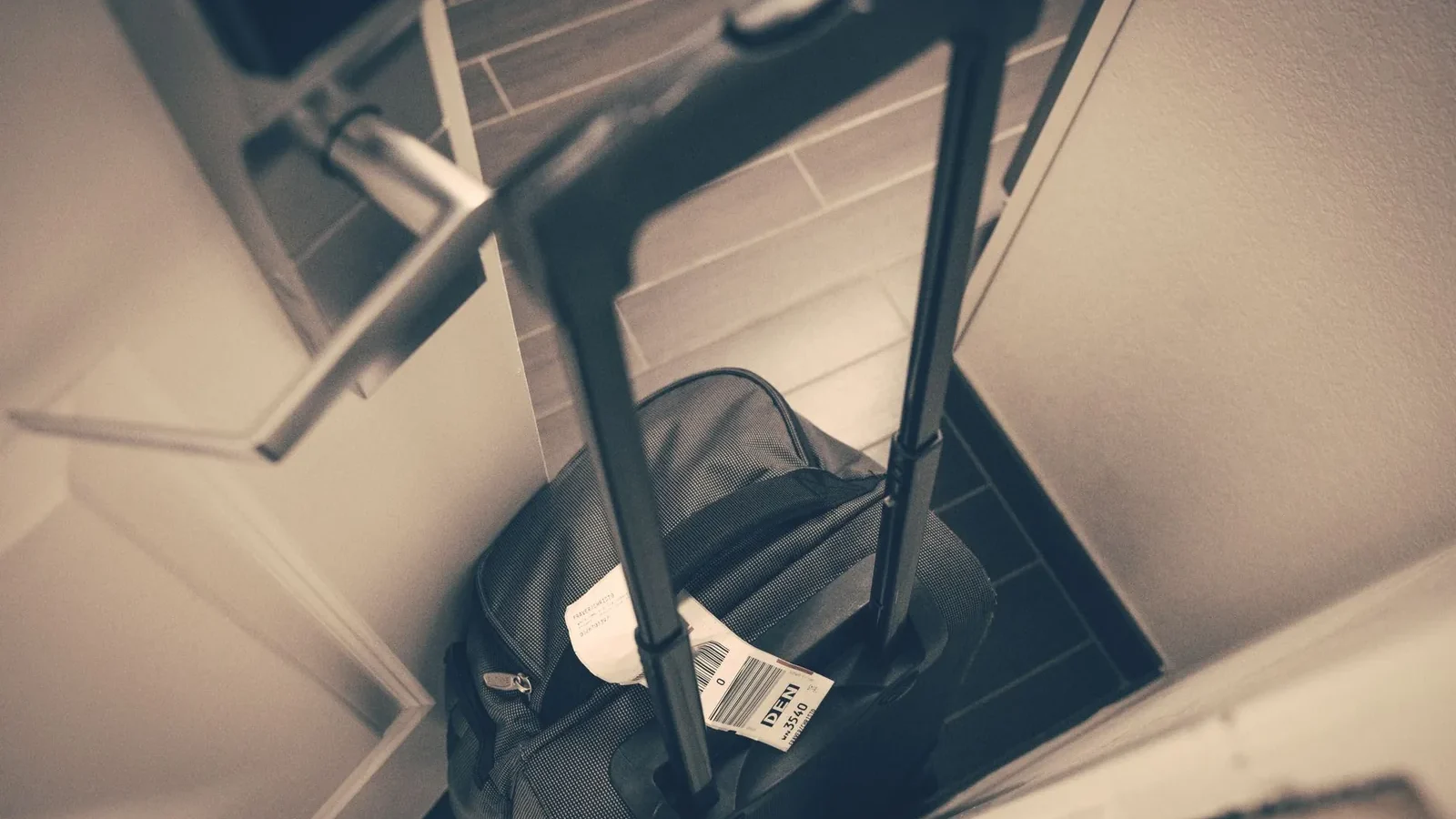
An AirTag in a pet crate is not banned outright, but it is not covered by the rule most people quote. The baggage-tracker allowance applies to your suitcase. An exported pet moves under the IATA Live Animals Regulations, which recommend removing electronic GPS trackers before crating and require any tracker that does travel to be declared to the airline. Australia and New Zealand will destroy it on arrival, and it goes silent in the hold anyway.
Introduction: the right question is which rulebook you are under
Search “can I put an AirTag in my pet’s crate” and almost every answer quotes the passenger baggage rule. That rule governs your suitcase. Your dog is not your suitcase. Once an animal is booked as cargo, a different regulation applies, and it says something quite different.
Owners ask us about trackers more than almost anything else in the last fortnight before a flight. The reason is obvious. You hand a sealed box containing your dog to a stranger at the cargo terminal, and then you know nothing for sixteen hours. A thirty-ringgit tracker feels like the cheapest anxiety cure available.
Every article we have read on the subject answers a question nobody asked. They cite the aviation authority ruling that lets you drop an AirTag into a checked suitcase, conclude that AirTags are therefore fine, and stop. That reasoning is sound right up to the point where the animal leaves the passenger system.
At My Pet Mover, almost every international move we handle out of KLIA travels as manifest cargo. Manifest cargo is governed by the live animal rules, not the baggage rules. Understanding an AirTag in a pet crate means reading three separate rulebooks and one law of physics, and only one of the four gives the comfortable answer.
Not sure whether your pet flies as cargo or as baggage?
It changes the crate rules, the paperwork and the tracker answer. See how each route out of Malaysia is flown →
Before the regulations, here is what the cargo journey actually looks like from the moment the crate leaves your hands.
Four rulebooks, four different answers
The confusion online comes from mixing four documents that each govern something different. Two of them permit trackers freely, one recommends removal and requires declaration, and one destroys anything found inside the crate. Only the last two apply to an exported pet.
We put the four side by side because owners are rarely told which one they are reading. What follows is compiled directly from the published text of each.
Chart 1: What each rulebook says about a tracker, and when it applies
| Rulebook | Position on trackers | When it applies to you |
|---|---|---|
| IATA Live Animals Regulations, Container Requirement 1 (Edition 52, January 2026) | Recommends the shipper removes electronic GPS trackers before crating; any tracker used must comply with the Dangerous Goods Regulations and be declared to the operator | Every dog or cat carried in the hold, as cargo or as checked baggage |
| IATA passenger lithium battery guidance, 2026 edition | Bag tags and GPS tracking devices are not restricted; a device at or below 0.3 g lithium metal or 2.7 Wh may stay switched on in checked baggage | Your own suitcase, not the animal |
| United States aviation guidance on baggage tracking devices | Permitted in checked baggage within the same 0.3 g and 2.7 Wh limits, with an instruction to check with the airline and a warning that international rules vary | Passenger baggage on United States flights |
| Destination biosecurity law | Australia instructs owners to place no items in the crate at all, and the crate is sealed by a government vet; New Zealand destroys bedding, toys and clothing on arrival | Every animal entering those countries, whatever the airline agreed |
Compiled by My Pet Mover, August 2026, from IATA Container Requirement 1, the IATA guidance for passengers travelling with lithium batteries, the FAA PackSafe entry on baggage with lithium batteries, the Australian step-by-step guide for dogs and the New Zealand guidance document.
Read down the third column and the pattern is clear. The two permissive entries are both about baggage. The two that bind an exported pet are the live animal regulation and the border. What goes inside the box is judged by the same two authorities that decide bedding and bowls, which we set out in detail in our guide to crate bedding, water and setup rules.
Why the baggage answer does not transfer
Passenger provisions cover items a passenger checks in under their own name on their own ticket. A pet moved as manifest cargo has an air waybill, a shipper, a consignee and a cargo acceptance check. Nothing in the passenger chapter reaches it.
The battery itself is genuinely harmless. An AirTag runs on a CR2032 lithium 3V coin battery, the same cell that sits in a car key fob. That falls comfortably under the thresholds that let tracking devices ride in a checked bag. Nobody in the industry believes a coin cell is a fire risk in the way a swollen power bank is.
The obstacle is jurisdiction, not chemistry. Cargo acceptance staff are trained on the live animal regulations and on the shipper’s declaration, and their checklist does not include a clause allowing you to attach personal electronics to a consignment. If the tracker was not declared, it is an undeclared item in an animal shipment, and that is a paperwork problem rather than a safety one. Our walkthrough of what happens at KLIA pet cargo on flight day shows where in that sequence the crate gets opened, inspected and sealed.
There is a second, quieter reason. Anything that has to be explained at the counter costs time in the acceptance window, and the acceptance window is the least forgiving part of the day.
Want the airline asked properly, in advance?
We raise trackers with the carrier at booking, not at the counter on departure morning. See how a full Malaysia to Germany move is sequenced →
What the live animal regulations actually require
Container Requirement 1 groups trackers with collars, harnesses and clothing, and recommends taking all of them off the animal before crating. It then adds a condition rather than a ban: a tracker that does travel must comply with the Dangerous Goods Regulations and be declared to the airline.
Grouping matters here. The regulation is not treating an AirTag as an aviation hazard. It is treating it as one more thing hanging off an animal that can catch, snag or be chewed inside a moving box. The same paragraph asks for collars, vests, harnesses and clothing to come off, and the reasoning is mechanical throughout.
The declaration clause is separate and stricter. Once a device travels, it stops being a private arrangement between an owner and their dog and becomes part of the consignment. Airlines that carry animals every week have processes for this; the ones that do not will simply say no. Which carriers are used on your route matters more than people expect, as our overview of IATA-approved crates and prices in Malaysia and the routing choices around them shows.
Worth noting too: the same regulation says a familiar article in the container helps to settle a pet animal. Owners often read that as licence to add a toy and a tracker. The destination usually disagrees, which is the subject of section 7.
Would an AirTag even work in the hold?
An AirTag has no GPS and no mobile connection. It broadcasts over Bluetooth and relies on someone else’s Apple device passing close enough to relay its position. Inside a metal cargo container at 35,000 feet there is no such device, so the tracker is dark for exactly the hours you care about most.
This is the part owners find hardest to accept, and it has nothing to do with regulation. The tracker is not being blocked. It is simply alone.
Chart 2: Where a Bluetooth tracker can and cannot report, hour by hour
| Elapsed | Stage | Likely to report? | Why |
|---|---|---|---|
| 0 h | Home to the cargo terminal | Yes | Your own phone is in the same vehicle |
| 1–4 h | Acceptance, documentation, holding area | Usually | Staff and other shippers carry phones nearby |
| 4–5 h | Build-up into the unit load device, ramp transfer | Patchy | Metal container, open apron, few people close by |
| 5–17 h | In flight | No | No passing devices in the hold to relay the signal |
| 17–19 h | Arrival, breakdown, transfer to the animal facility | Patchy | Depends entirely on handler phones in range |
| 19 h onward | Border inspection or quarantine | No | Restricted area, and the device may already be removed |
Illustrative sequence modelled by My Pet Mover, August 2026, on a typical long-haul routing from Kuala Lumpur. Stage timings are our own operational estimate; reporting behaviour follows from the fact that these trackers use Bluetooth rather than GPS or mobile data.
Look at the gap between hours five and seventeen. That is the stretch owners lie awake for, and it is precisely the stretch no consumer tracker covers. What actually protects an animal in that window is temperature-controlled loading and a carrier that handles animals routinely, which we cover in whether pets travel safely in the cargo hold.
Destinations that will take it off you
Australia tells owners to place no items in the crate at all, because anything inside is destroyed as biosecurity waste, and the crate travels sealed by a government veterinarian. New Zealand destroys bedding, toys and clothing on arrival for ectoparasite control. A tracker inside either crate is a tracker you have thrown away.
Biosecurity is where a permitted tracker quietly becomes a pointless one. The border is not asking whether the device is safe. It is asking whether anything riding in with the animal could carry a pest, and the cheapest answer to that question is to destroy it.
Chart 3: How four destination groups treat items travelling inside the crate
| Destination | Items allowed inside | Crate sealed on departure | Practical outcome for a tracker |
|---|---|---|---|
| Australia | None at all, including toys, medication and items of value | Yes, sealed by the official government veterinarian and the seal must be intact on arrival | Destroyed as biosecurity waste; do not put one in |
| New Zealand | Inert bedding only; no straw or hay | Sealing applies under the import health standard | Bedding, toys and clothing destroyed on arrival for ectoparasite control |
| European Union destinations | No equivalent blanket destruction instruction published | Not routinely required | Usually survives, but the airline rule still governs departure |
| Quarantine destinations generally | Varies by import health standard | Frequently required | Assume removal at inspection and plan not to see it again |
Compiled by My Pet Mover, August 2026, from the Australian department’s step-by-step guide for dogs and the New Zealand cats and dogs guidance document. Entries for other destinations are our own operational summary.
The sealed-crate rule deserves its own sentence. Once a government vet has closed and sealed the box in Malaysia, nobody opens it until the border does. That seal is the whole point of the exercise, and it is why Australia-bound moves are the strictest we handle.
Different border, different answer.
What survives arrival depends on where your pet lands, not on what you paid for the tracker. Check the rules for your destination route →
Inside, outside, or not at all: the options scored
An AirTag in a pet crate is only one of four realistic choices. The others are a tracker taped to the outside, one on the animal’s collar, and none at all with airline milestone tracking used instead. Scored against acceptance risk, survival and usefulness, the last option wins on every route we fly.
We scored each option out of ten on how likely it is to survive the whole journey and still tell you something you did not already know.
Chart 4: Tracking options scored out of 10 for real-world usefulness
| Option | Usefulness score out of 10 | Main weakness |
|---|---|---|
| Tracker loose inside the crate |
2 / 10 |
Chewable, destroyed at strict borders, breaks the seal question |
| Tracker taped to the outside |
4 / 10 |
Still must be declared; silent in flight; often peeled off in handling |
| Tracker on the animal’s collar |
1 / 10 |
Directly against the removal recommendation; snag risk on a live animal |
| No tracker; airline milestone tracking |
9 / 10 |
Updates at checkpoints rather than continuously |
Scores are My Pet Mover’s own operational assessment, August 2026, based on shipments handled out of Kuala Lumpur. They weigh acceptance risk at the cargo counter, survival through border inspection, and whether the option tells the owner anything the air waybill does not.
The scoring surprises people. The winning option is the one that costs nothing and involves no device at all: the air waybill number, which the carrier updates as the consignment is accepted, loaded, flown and delivered. It is not live, but it is accurate, and it is read by the same people who can act on it. Sea shipments work on a similar principle, as we explain in whether pets can travel by sea from Malaysia.
What we do instead
We give owners the air waybill number, confirm acceptance in writing, confirm loading, and confirm arrival with the receiving agent. On a delay we call the carrier rather than refresh an app. That sequence produces better information than any consumer tracker, because a person on the ground is the one reporting.
Our practice on every export is the same four confirmations:
- Accepted. The crate has passed the cargo check and the air waybill is live. This is the moment most owners actually want.
- Loaded. The consignment is on the aircraft rather than rolled to the next service.
- Landed. The receiving agent has the animal and inspection is under way.
- Released. Border clearance is complete and the pet is on its way to the door or into quarantine.
None of that requires a battery. It does require someone to be awake in the right time zone, which is the actual service being bought. If a flight goes wrong, the useful action is a phone call to the carrier’s animal desk, not a map refresh. Our piece on what happens when a pet’s flight is delayed or cancelled sets out how that plays out.
If an owner still wants a tracker, we will ask the airline at booking. Sometimes the answer is yes with the device taped externally and declared. We would rather ask six weeks early than argue about it at the counter on departure morning.
Conclusion: allowed is not the same as useful
An AirTag in a pet crate is permitted in principle, discouraged by the live animal regulations, conditional on airline declaration, destroyed at strict borders and silent for the flight itself. Each layer takes something away until nothing useful is left.
The honest summary is that the device is not dangerous and not forbidden. It is just the wrong tool. It answers a question about location using a technology that needs a crowd, and the crate spends its most worrying hours in the emptiest place on the aircraft.
Owners who ask about trackers are really asking to be told their animal is fine. That reassurance exists, but it comes from an air waybill, a carrier that flies animals every week and an agent who picks up the phone. Choosing the right routing does more for a pet than any gadget, which is where our route-by-route guidance starts.
Frequently asked questions
Can I put an AirTag in my pet’s crate?
There is no outright ban on an AirTag in a pet crate. The IATA Live Animals Regulations recommend that shippers remove electronic GPS trackers before crating, and require any tracker that does travel to comply with the Dangerous Goods Regulations and be declared to the operator. Ask the airline at booking rather than assuming.
Is an AirTag a dangerous good?
Not in the way a power bank is. It runs on a CR2032 lithium coin cell, which falls under the small thresholds that let baggage tracking devices travel in checked bags. The issue with a pet export is that the animal is a cargo consignment, so the tracker has to be declared rather than simply tolerated.
Will an AirTag work during the flight?
No. AirTags have no GPS and no mobile connection; they broadcast over Bluetooth and depend on a nearby Apple device relaying the position. Inside a cargo hold there is no such device, so the tracker reports nothing for the whole flight.
Can I send a tracker with a pet going to Australia?
No. The Australian department instructs owners to place no items in the crate at all, including toys, medication and items of value, because anything inside is destroyed as biosecurity waste on arrival. The crate also travels sealed by the official government veterinarian.
What about New Zealand?
New Zealand permits inert bedding only and destroys bedding, toys and clothing on arrival for ectoparasite control. A tracker sent inside the crate should be treated as a tracker you will not get back.
Is a GPS pet tracker better than an AirTag for a flight?
A true GPS tracker with a mobile connection has bigger batteries and more regulatory weight, so it is likelier to need airline approval, not less. Either way the live animal regulations still ask for removal before crating and declaration if used.
How do I know where my pet is if I cannot use a tracker?
Use the air waybill number. The carrier updates it as the consignment is accepted, loaded, flown and delivered, and a good agent confirms each stage with you directly. It is not live, but it comes from people who can act on a problem.
Want to know exactly where your pet is, without guessing?
We handle the airline conversation, the crate check and every arrival confirmation on your behalf, from KLIA to the door at the other end.