Pet crate setup for flight is governed by two rulebooks that do not agree. IATA and your airline decide what the crate must carry — absorbent bedding, an open water bowl fixed inside the door, a food container. The destination's biosecurity service decides what survives the landing, and Australia and New Zealand destroy almost everything inside. Set the crate up for the stricter of the two.
Introduction: the crate passes, the contents fail
Most owners research crate size and stop there. The interior is what gets challenged at the cargo counter — a water bowl that cannot be filled from outside, bedding that is not absorbent, a favourite toy that the destination will incinerate. Pet crate setup is a separate task from crate selection.
By the time a family reaches us at My Pet Mover, the crate is usually already bought. Right length, right height, metal doors. That part is solved.
What is rarely solved is the inside. Owners treat it as the soft part of the job — a blanket, a bowl, a chew toy. Every item in that box is either required by the carriage rules, permitted by them, or destined to be destroyed the moment the animal lands.
Two authorities have a say and they are not co-ordinated. The airline applies the IATA Live Animals Regulations, because that is what its acceptance staff are trained on. The destination applies its own biosecurity law, which cares nothing for comfort and a great deal about what plant and animal material is riding in with your dog. Correct pet crate setup for flight means satisfying both, and obeying the stricter one where they clash.
Not sure which rulebook applies to your route?
Crate contents rules change with the destination, not with the airline you book. Check the requirements for your route →
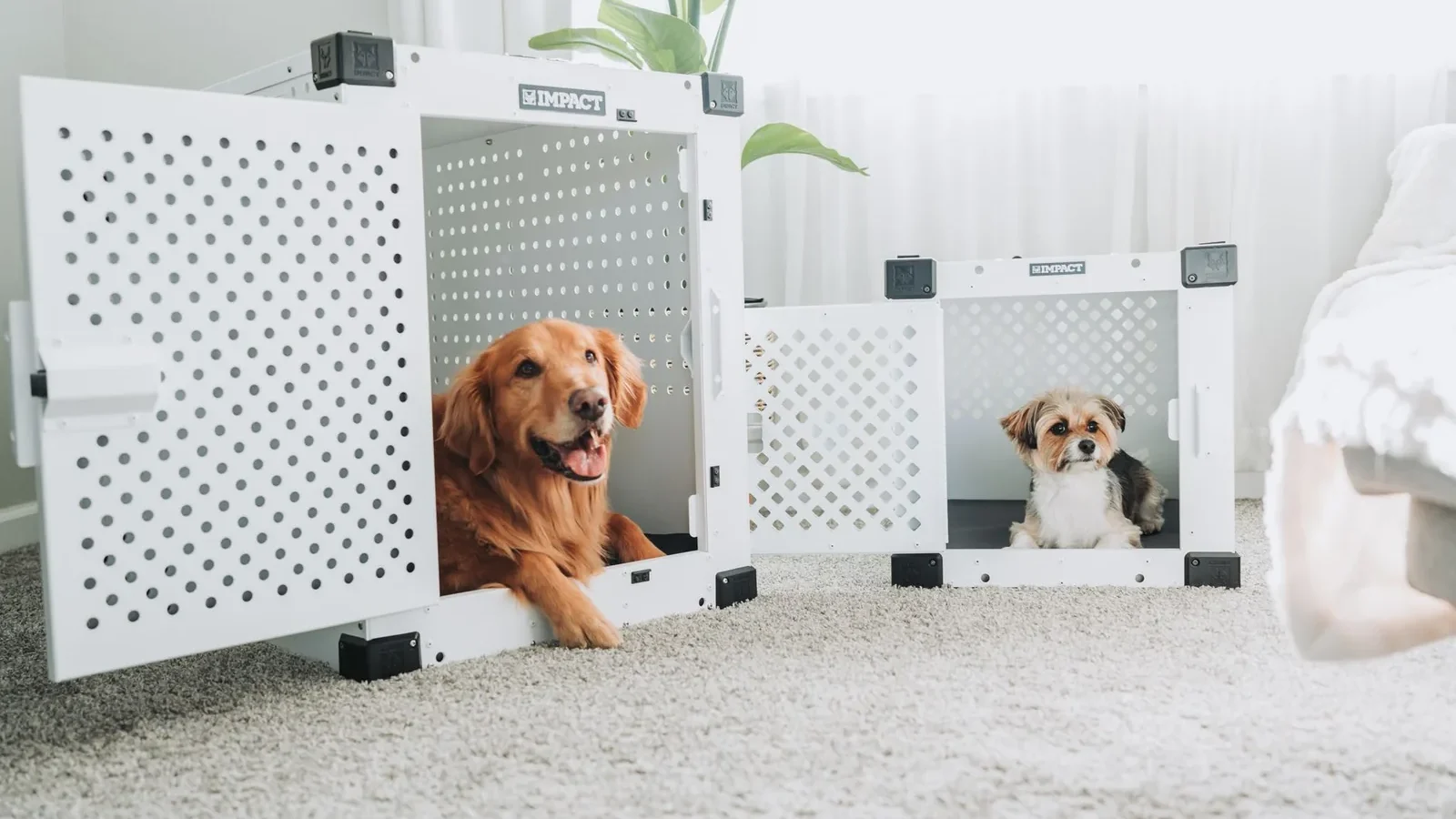
Before the detail, here is what a correctly assembled airline crate looks like from the outside in.
What actually goes inside a pet crate for a flight?
Four things, and almost nothing else: absorbent bedding suitable for the species, an open water container fixed inside the door, a food container fixed inside or attached to the crate, and the documents in a waterproof pouch taped to the roof. Everything beyond that list is optional at best.
Container Requirement 1 of the IATA Live Animals Regulations is the document your check-in agent is working from. It is short on the interior and specific where it counts:
- Bedding. “Absorbent bedding that is suitable for the species must be provided.” That is the whole rule — absorbency is the test, not softness.
- Water container. Present, affixed inside, open on the top surface, and fillable from outside without opening the door.
- Food container. Inside the crate if the crate is sealed, or attached to it. Food itself may be attached for use if the flight is delayed.
- Documents. Not an IATA interior rule, but every border in the region expects the health certificate and permit to travel with the animal.
Notice what is not on that list. There is no requirement for a blanket, a toy, a worn T-shirt or a bowl of kibble. Those are choices, and every one is a choice the destination may reverse.
Bedding: absorbent first, comfortable second
Bedding exists to absorb urine, spilled water and vomit so the animal is not lying in it for fourteen hours. It is a hygiene component, not a comfort item. Thick, high-sided or plant-based bedding fails on two grounds at once — it steals headroom and it triggers biosecurity screening.
The mental shift that saves owners the most trouble is this one: bedding is drainage, not décor. A folded quilt looks kind. It also holds liquid against the animal’s coat and gets pushed into a corner during turbulence, leaving a bare plastic floor.
New Zealand states the position bluntly in its cats and dogs import guidance: no straw or hay bedding is permitted, only inert bedding, and any bedding or toys in the crate are destroyed on arrival for ectoparasite control. Singapore Airlines puts the same rule in one line on its pet acceptance checklist — there must be a blanket or other absorbent material, and straw is prohibited.
Height matters more than owners expect. IATA’s sizing formula tells you to add the height of the bedding when you calculate the internal height of the crate, because the animal must still stand without its ears touching the roof. A crate measured to the millimetre and then loaded with a thick cushion is no longer compliant. Our guide to measuring your dog for an IATA crate shows where that margin comes from.
Water and food containers: the rule owners get wrong
The water container must be open on top, securely fixed inside the crate so it cannot be dislodged, and reachable for refilling from outside without opening the door. A drip bottle does not satisfy this. IATA states plainly that bottles and similar dispensers must not replace an open container.
This is the single most common fault we correct during pre-flight checks. Owners buy the rodent-style bottle because it does not spill. It is also the one fitting the regulations specifically rule out: a ground handler must be able to top up a dish through the door grille during a delay, and an animal in distress must be able to drink freely rather than work a valve.
The United States codifies the same principle. Under 9 CFR Part 3, Subpart A, food and water receptacles must be securely attached inside the primary enclosure and positioned so they can be filled from outside without opening the door. Two jurisdictions, one design requirement.
The practical version we use on every export is straightforward:
- Bolt both dishes to the door grille. Not the floor. Floor dishes get stepped in, tipped over, and cannot be refilled from outside.
- Freeze the water dish overnight. A block of ice does not slosh out during loading and melts into drinking water over the first hours of the journey.
- Attach a sealed bag of the animal’s own food. IATA allows food to be attached for use in case of delay, and handlers will use it if a flight goes badly wrong.
- Tape feeding instructions beside the food. One line, in English, stating the portion and the timing.
What each rulebook demands inside the crate
Carriage rules and border rules pull in opposite directions on personal items. IATA suggests a familiar article helps settle an animal. Australia instructs owners to place no items at all in the crate. When a carriage guideline meets a border instruction, the border instruction wins.
Crate Interior Rules, Four Rulebooks Compared
| Item | IATA Container Requirement 1 | Destination biosecurity | Carrier checklist |
|---|---|---|---|
| Bedding | |||
| Material | Absorbent bedding suitable for the species must be provided | New Zealand: no straw or hay, inert bedding only | Singapore Airlines: blanket or other absorbent material, straw prohibited |
| On arrival | Not addressed | New Zealand: bedding destroyed for ectoparasite control | Not addressed |
| Water and food | |||
| Water container | Affixed inside, open on top, fillable from outside; bottles must not replace it | Australia: agent to advise how to attach water containers | Singapore Airlines: firmly attached within, outside access for filling |
| Food container | Inside if sealed, or attached; food may be attached in case of delay | Australia: food and water for the journey allowed, method agreed with airline | Singapore Airlines: sealed food may be attached outside the kennel |
| Personal items | |||
| Toys and comfort items | A familiar article helps to placate the animal | Australia: place no items at all, including toys, in the crate | Not addressed |
| Collars and trackers | Remove collars, harnesses and electronic GPS trackers before crating | Australia: crate sealed by the government veterinarian | Singapore Airlines: no leash or muzzle; flat collar only |
Compiled by My Pet Mover, August 2026, from the IATA Container Requirement 1, the New Zealand cats and dogs guidance document, the Australian Group 3 step-by-step guide for dogs and the Singapore Airlines pet checklist.
Read the personal-items rows together and the conflict is obvious. IATA, writing about welfare in transit, encourages a familiar article. Australia, writing about what may cross its border, instructs owners to place nothing in the crate at all, because anything inside is destroyed as biosecurity waste on arrival. Both are correct in their own jurisdiction. Only one decides what happens when the aircraft doors open.
Moving a pet to a strict-entry country?
Australia and New Zealand seal, inspect and strip the crate on arrival, so the interior has to be planned months ahead. See how pet export from Malaysia works →
The countdown: when to feed, water and load
IATA asks for a light meal at least two hours before dispatch, then a short drink and exercise immediately before crating. Animals must not fly within two hours of a meal. The last day of a pet crate setup runs to a clock, and the clock is set backwards from the departure time.
Departure-Day Countdown, Hours Before Flight
| Step | Hours before departure | Timing |
|---|---|---|
| Freeze the water dish | 24 hours | |
| Latest carrier acceptance window | 6 hours | |
| Food and water offered before hand-over | 4 hours | |
| Light meal before dispatch | 2 hours | |
| Short drink, walk, then crate | Immediately |
Bars scaled to a 24-hour window. Feeding, watering and exercise timings from IATA Container Requirement 1; acceptance and pre-hand-over timings from 9 CFR Part 3, Subpart A. Frozen-dish timing is My Pet Mover’s own departure practice.
The four-hour and six-hour markers come from the United States transport standard, which bars a carrier from accepting a dog or cat more than four hours before scheduled departure, extendable by agreement to six, and requires the shipper to certify that food and water were offered in the four hours before hand-over. Even where that rule does not legally apply, it describes the window most cargo terminals work to.
What the crate has to cope with in the air
Animals do not normally need extra feeding in the twelve hours after dispatch, but water must be provided once total journey time passes twelve hours. On a Kuala Lumpur to Europe routing that threshold arrives while the aircraft is still airborne, which is why the dish design matters.
Elapsed Hours From Crating on a Long-Haul Routing
| Elapsed time | Stage | What the crate interior is doing |
|---|---|---|
| Hour 0 | Crating at the facility | Frozen dish fitted, bedding flat, cable ties on all four door corners |
| Hour 2 | Cargo acceptance and inspection | Staff check dish access, fasteners, ventilation and labels through the grille |
| Hour 4 | Loading into the hold | Ice begins melting into drinkable water; spacers keep ventilation clear |
| Hour 8 | Mid-flight | Bedding absorbing any accident; no feeding required at this point |
| Hour 12 | IATA watering threshold | Water must be provided beyond this point on the total journey |
| Hour 16 | Arrival and border handling | Contents inspected; bedding and any items removed as biosecurity waste |
Illustrative sequence modelled by My Pet Mover, August 2026, on a long-haul routing from Kuala Lumpur. Feeding and watering thresholds from IATA Container Requirement 1.
The twelve-hour line is why we treat the water dish as a design decision rather than an accessory. Nobody opens the door in flight. Whatever the animal drinks after hour twelve has to already be in the crate, reachable, and still in the dish rather than soaked into the bedding. Owners planning a move from Malaysia to Germany are looking at exactly this kind of elapsed time once transit is counted.
Bedding materials, scored against the real tests
A bedding material has to pass three tests: it absorbs liquid, it contains no plant or animal material that biosecurity will flag, and it lies flat enough not to eat the crate’s headroom. Shredded newspaper and veterinary dry-bed pass all three. Straw fails on all three.
Bedding Materials Against Three Practical Tests
| Material | Absorbent | Accepted under published rules | Effect on crate height |
|---|---|---|---|
| Shredded newspaper | Yes | Yes | Minimal when spread thinly |
| Veterinary dry-bed pad | Yes, wicks to the underside | Yes | Minimal |
| Disposable absorbent pad | Yes | Yes, best used under a top layer | None |
| Folded blanket or towel | Yes, but holds liquid against the coat | Yes, named on carrier checklists | Noticeable if thick or bunched |
| Straw or hay | Poorly | No, prohibited by New Zealand and by carrier checklists | Significant |
| Wood shavings or litter | Yes | Avoided in our practice; scatters through ventilation | Moderate |
Compiled by My Pet Mover, August 2026, against the absorbency rule in IATA Container Requirement 1, the inert-bedding rule in the New Zealand guidance document and the Singapore Airlines pet checklist. Height effects are our own operational assessment.
Our standard build for pet crate setup for flight is a disposable absorbent pad on the floor with a thin layer of shredded newspaper over it. The pad catches liquid, the paper keeps the animal off the wet surface, and neither adds height worth measuring. It is cheap to replace, which matters when the whole lot is destined for an incinerator at the other end.
Toys, collars, leashes and trackers: what stays behind
Leashes and muzzles must not be left in the crate. IATA recommends removing collars, harnesses, clothing and electronic GPS trackers before crating, and any tracker that does travel must comply with the Dangerous Goods Regulations and be declared to the operator.
Every item on this list has a reason behind it, and the reasons are mechanical rather than bureaucratic:
- Leashes and long collars catch. A trailing lead is a strangulation risk during turbulence, which is why carrier checklists exclude them while still permitting a plain flat collar.
- Correction collars are banned. Shock and choke collars appear by name on airline prohibition lists; a flat collar with an ID tag is the accepted alternative.
- Trackers are dangerous goods. Lithium batteries in the hold are regulated cargo, and IATA is explicit that trackers must be declared. We cover this in our piece on whether AirTags are allowed in pet crates.
- Toys become biosecurity waste. New Zealand destroys them on arrival; Australia asks that nothing be placed in the crate at all.
Owners often ask whether a worn T-shirt would settle the animal. It might, on the aircraft. It will also be taken and destroyed at a strict border, and losing it upsets the family more than the flight upset the dog. If comfort is the concern, the answer is preparation rather than possessions — a crate the animal already sleeps in willingly. Our guide to crate training before an overseas move covers how that is built over weeks, not on the morning of the flight.
Want the crate checked before the airport does it?
We fit, seal and inspect every crate ourselves before it reaches the cargo terminal. Compare IATA crate sizes and prices in Malaysia →
Setup faults we correct before the airport does
The recurring faults are a water bottle instead of an open dish, plastic clips holding the crate halves together, bedding piled too high, and a crate that has never been slept in. All four are fixable in an afternoon if they are found before departure day.
These are the ones we see most often on crates owners have prepared themselves:
- Bottle instead of bowl. The regulations rule out bottles as a replacement for an open container. Swap it for two bolted dishes on the door.
- Plastic clips only. Where a crate assembles from a top and bottom half, plastic clips must not be the only fasteners; acceptance staff look for metal nuts and bolts in every hole.
- Bedding piled high. Headroom is measured with the bedding in place. A cushion turns a compliant crate into a rejected one.
- Wheels left on. If a crate has wheels, they must be removed or rendered inoperable before it is presented.
- An unfamiliar crate. Not a compliance fault, but the one that shows most on arrival. An animal loaded into a box it met that morning travels far worse than one that has napped in it for a month.
None of these are exotic. They follow from treating the crate as luggage rather than as the animal’s enclosure for most of a day. Our explainer on entry permits for pets sets out what has to be in place long before the crate is packed.
Conclusion: build for the stricter rulebook
Correct pet crate setup for flight comes down to one habit: satisfy the carriage rules in full, then remove anything the destination will confiscate. What remains is absorbent bedding, two open dishes on the door, sealed food attached outside, and a flat collar.
The interior of a travel crate is not a place to express affection. It is a small regulated environment that has to keep an animal dry, hydrated and safe for up to sixteen hours, then survive an inspection by a service whose job is to assume everything inside carries a pest.
Owners who grasp that early tend to have uneventful departures. They buy the crate months out, let the animal sleep in it, fit the dishes properly, and send nothing they mind losing. The rest of the route — permits, tests, timing — is covered across our international pet transport route guides.
Frequently Asked Questions
1. What bedding should I put in a pet crate for a flight?
Use absorbent, inert bedding that lies flat — a disposable absorbent pad with a thin layer of shredded newspaper over it works well. IATA requires absorbent bedding suitable for the species. Avoid straw and hay, which New Zealand prohibits outright and carrier checklists also exclude.
2. Can I use a water bottle instead of a bowl in the crate?
No. IATA states that water bottles and similar dispensers attached inside or outside the crate are not open containers and must not be used to replace one. The water container must be open on top, fixed inside the crate, and fillable from outside without opening the door.
3. Can I put a toy or blanket in my pet’s crate?
It depends on the destination. IATA notes that a familiar article helps settle an animal, but Australia instructs owners to place no items at all in the crate, and New Zealand destroys bedding and toys on arrival for ectoparasite control.
4. When should I feed my pet before a flight?
IATA advises a light meal at least two hours before dispatch, then a short drink and exercise immediately before crating. Animals must not fly within two hours of a meal. United States transport standards also require the shipper to certify that food and water were offered in the four hours before hand-over.
5. Does my pet need food and water during the flight?
Animals do not normally require additional feeding during the twelve hours after dispatch, but water must be provided if the total journey time exceeds twelve hours. Attaching sealed food to the crate covers the possibility of a long delay.
6. Can my dog wear a collar or leash inside the crate?
A plain flat collar is generally accepted. Leashes and muzzles must not be left in the crate, and correction collars such as shock or choke collars are prohibited. IATA also recommends removing harnesses, clothing and electronic trackers before the animal is crated.
Ready to move your pet overseas?
Tell us the destination and the animal, and we will confirm the crate size, build the interior to the destination’s rules, and map the permits, tests and timings your route needs.