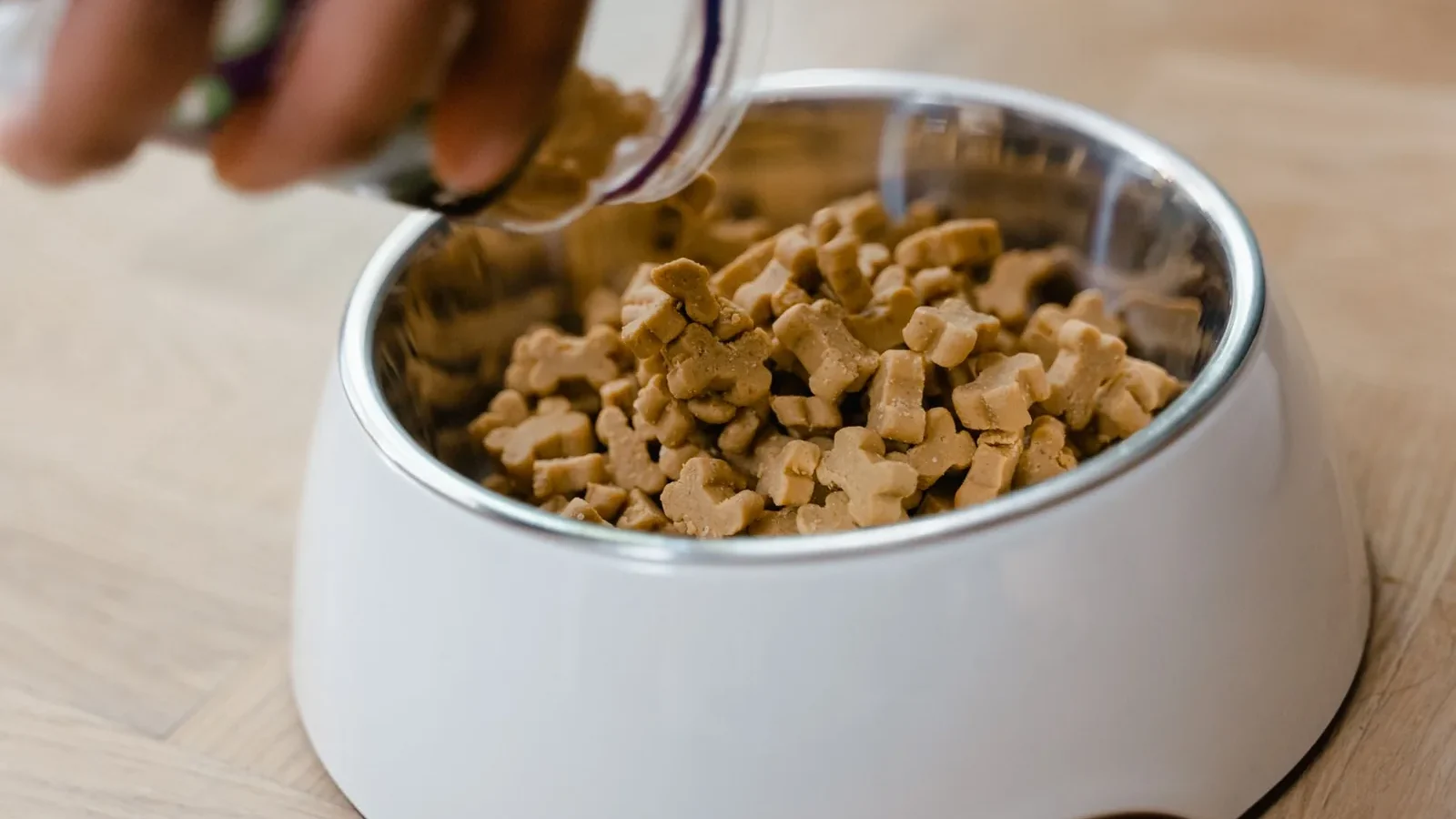
The rules on feeding pet before flight are more specific than owners expect: a light meal at least two hours before handover, a short drink, a walk, then nothing. Water is the part that matters. It must sit in an open dish fixed inside the crate door and refillable from outside, never a bottle. Past twelve hours of total journey time, water stops being optional.
Introduction: the question that arrives the night before
Feeding is the last thing an owner thinks about and the first thing a handler checks. Permits get months of attention. The meal before departure gets decided at the kitchen counter, often on advice that contradicts what the airline holds you to.
By the time the crate is standing in the hallway, the hard part is over. The permit is issued, the titre test has cleared, the flight is booked.
Then the animal looks hungry, and the owner has to decide something with no obvious right answer. Feed it, and risk vomiting inside a container nobody can open for hours. Skip it, and send the animal away empty.
What most owners never learn is that the decision is not theirs alone. The airline standard sets out what should be offered and when, and on some routes national law does too. What follows is the rulebook version, applied to an international pet move leaving Malaysia. The crate walkthrough below shows where the dishes physically go.
Feeding pet before flight: what IATA and the USDA actually require
Two rulebooks apply, and they do not say the same thing. IATA asks for a light meal at least two hours before dispatch. United States rules ask that food and water were offered within four hours of reaching the airport, with the time written down.
Most advice online reduces feeding pet before flight to two words: don’t feed. The published standards are more precise, and that precision protects you if a handler questions the shipment.
IATA’s guidance for pet owners asks you to reduce food the day before while still giving enough water. A light meal follows two hours before the animal is tendered to the carrier. Container Requirement 1 of the Live Animals Regulations repeats that two-hour figure, adds a short drink and exercise immediately before crating, and warns that no animal may fly within two hours of a meal.
The American rule is a different shape. Under the Animal Welfare Act standards summarised by USDA APHIS, the owner or their agent must certify that food and water were offered within four hours of delivery to the airport. The date and time go on a document in the pouch attached to the crate.
Food And Water Countdown To Handover
| Window | Food | Water | Whose rule |
|---|---|---|---|
| The day before | Reduce the quantity | Enough, unrestricted | IATA owner guidance |
| Within 4 hours of the airport | Offered; time recorded | Offered; time recorded | USDA APHIS, US routes |
| At least 2 hours before dispatch | A light meal | A short drink | IATA CR1 |
| Immediately before crating | Nothing further | None; exercise instead | IATA CR1 |
| First 12 hours after dispatch | Not normally required | Open dish in the crate | IATA CR1 |
| Past 12 hours | Every 24h from 16 weeks; 12h below | Provided at least every 12 hours | IATA CR1 and USDA APHIS |
Source: IATA LAR Container Requirement 1 (Ed. 52, 2026) and USDA APHIS, 2026. Licence.
Read the two together and the safe window falls out on its own. A light meal two to four hours before you leave for the airport satisfies both. That is the timing we work to on every animal we send overseas from Malaysia.
When to feed dog before flight — and when to stop
Work backwards from the time you hand the crate over, not from take-off. Cargo check-in for an international pet usually closes several hours before departure, so a meal timed against the flight can easily land inside the forbidden window without the owner realising.
The most common mistake in feeding pet before flight is not overfeeding. It is using the wrong clock.
An owner sees a 23:30 departure, feeds at 19:00, and believes there is a four-hour gap. In practice the animal was tendered at 18:30, and the meal came afterwards in the car park.
A workable order for the last day, drawn from the IATA guidance above:
- Halve the evening meal the day before. Keep water normal. A lighter gut travels better and produces less to clean up.
- Give the last meal two to four hours before you leave the house. Small, familiar food. Not the moment to introduce anything new.
- Offer a short drink with it, then leave the bowl down. Restricting water to avoid accidents is the one shortcut that causes harm.
- Walk the animal immediately before crating. IATA asks for exercise at this point, and it empties the bladder before a long confinement.
- Write down the time food and water were last offered. On several routes this is not a courtesy but a document that travels with the crate.
Cats need the same timing with a lighter hand. Anxiety-driven nausea is common, and a cat already living with its carrier for weeks usually eats a small meal calmly. One meeting the box for the first time will not eat at all.
Not sure when your crate has to be handed over?
Handover times differ by airline, route and season, and everything on the day is timed off them. See how flight day works at KLIA →
Why a water bottle pet crate setup fails an inspection
A water bottle pet crate arrangement is a common reason a container is turned back. IATA states plainly that bottles and similar dispensers are not open containers and must not replace them. The dish has to be open on top and fixed inside the door.
Bottles look tidy. They do not spill, and pet shops sell them beside the travel crates. None of that makes them compliant.
Container Requirement 1 asks for a water container affixed inside the crate, open on its top surface, secured so it cannot be dislodged, and reachable from outside for refilling. A bottle fails the open-top test. USDA guidance goes further and says water bottles should not be attached to the outside of the kennel at all.
Feeding Hardware By Where The Pet Travels
| Item | In the hold | In the cabin | US routes |
|---|---|---|---|
| Open water dish, fixed inside | Required | Not required | Required, inside door |
| Refill access without opening | Required | Not required | Required |
| Food dish | Inside or attached | Not required | Required, inside door |
| Spare food for delays | May be attached outside | Owner carries it | In a plastic container |
| Bottle or sipper dispenser | Cannot replace the dish | Owner’s discretion | Not on the outside |
| Feeding instruction sheet | Carrier practice | Not applicable | Required in the pouch |
Source: IATA LAR Container Requirement 1 (Ed. 52, 2026) and USDA APHIS, 2026. Licence.
A cabin carrier is exempt from the dish requirement entirely, one more reason the choice between cabin and cargo changes the packing list. The dishes also count when measuring the crate against the IATA formula, since they take floor space the animal needs to turn in.
What goes in the pouch: the instructions nobody writes
A crate travelling into the United States must carry a document stating when food and water were last offered, plus feeding instructions for the next 24 hours. Many owners never write one, so a handler facing a delay has nothing to work from.
How to write the feeding and watering instruction sheet
The sheet lives in the plastic pouch taped to the crate, beside the health certificate and routing details. It is the only way your instructions survive the handover.
- Record the last feed and drink. The date and clock time, in 24-hour format, with the time zone named.
- State the food and the portion. Brand and amount for one meal, so nobody guesses a quantity during a delay.
- Set the schedule for the next 24 hours. The times food should be offered, plus a note that water may be topped up at any point.
- Add anything medical. Allergies, a prescription diet, or a warning that the animal will not eat when stressed.
Then attach the food. IATA allows it to be fixed to the outside of the crate for use in case of delay. If a handler does have to feed, the standard names meat, biscuits or canned food, warns against overfeeding, and repeats that the animal must not fly within two hours of eating.
That last line matters on a routing with a long layover. A meal given at the wrong point in a transit hall can delay the onward sector.
The hydration long haul pet journeys need past hour 12
IATA treats twelve hours as the line where water changes from good practice to a requirement. Total journey time, not flight time, is what counts. Once handover and clearance are added, several routes out of Kuala Lumpur cross that line without a stopover.
Owners judge a journey by the number on the ticket. The animal experiences something longer: the drive to the airport, the wait in the cargo terminal, the flight, the wait on arrival, and the clearance queue. The hydration long haul pet moves depend on is measured across that whole span.
Journey Time Vs The 12-Hour Water Line
| Route from KUL | Modelled total journey | Hours | Past 12 hours? |
|---|---|---|---|
| Singapore | 7 | No | |
| Hong Kong | 10 | No | |
| Tokyo | 13 | Yes | |
| Dubai | 14 | Yes | |
| London | 20 | Yes | |
| Toronto, one stop | 26 | Yes |
Illustrative model: published nonstop block times plus typical handover and clearance windows, 2026. Licence.
A pet flying to Tokyo on a single sector, with no transit at all, is already on a journey where water must be provided. Add one connection and the question stops being close.
Malaysian departures carry a second load. Humidity and apron heat push an animal to pant before it has boarded, part of why airlines impose seasonal heat embargoes and why an early departure is worth paying for.
Want the timings worked out for your route?
We build the flight-day schedule around the routing, the season and the receiving country’s clearance hours. See what a full relocation includes →
Which animals need a different plan
Young animals, flat-faced breeds and older pets all lose water faster or tolerate an empty stomach less well. The published rules already treat them separately, and the differences are large enough to change what you pack.
The standard timings assume a healthy adult dog or cat. Several groups sit outside that assumption:
- Puppies and kittens. IATA refuses weaned animals under eight weeks specifically because of dehydration risk in the air, and under sixteen weeks the feeding interval halves to twelve hours. Check the minimum age rules for young animals before booking.
- Snub-nosed breeds. Panting is how a dog sheds heat, and panting costs water. A flat-faced breed already restricted by most airlines dehydrates faster than a long-nosed one on the same routing.
- Older animals. Kidney function and thirst response both decline with age. Preparing a senior pet for an overseas move usually means a vet conversation about water, not only a fitness check.
- Pets on prescription diets. Send the actual food. A handler feeding during a delay will otherwise use whatever the airline has.
The anxious animal is a different case. The temptation is medication, and sedation before a flight carries risks that outweigh the calm, including a suppressed thirst response at the worst possible moment.
Hour by hour on a 22-hour move
Laid out across a real timeline, the food and water plan is mostly a plan about who can act. For roughly nine hours in the middle nobody can reach the animal, which is why the hardware and paperwork matter more than the meal.
The table tracks a Malaysia to Europe routing with one transit stop, from the last meal at home to arrival at the destination cargo terminal.
Food, Water And Access Across 22 Hours
| Stage | −3h | 0h | +4h | +13h | +22h |
|---|---|---|---|---|---|
| Food | Light meal at home | None; spare food taped on | None needed | Only if delayed | Small meal on release |
| Water | Short drink; bowl down | Dish filled; frozen block | Melting in the dish | Topped up in transit | Offered on arrival |
| Who can act | Owner | Cargo staff | Nobody, in flight | Transit handlers | Agent or consignee |
Illustrative model based on IATA CR1 feeding and watering rules, 2026. Licence.
The frozen block is the one trick worth knowing. A full bowl of liquid empties itself during loading; the same volume frozen the night before travels intact and melts into drinkable water over the first hours of the flight.
Note how short the owner’s window is. It closes at handover, and everything after runs on hardware, labels and the sheet in the pouch, which is also why the hold is safer than most owners assume.
Conclusion: a small decision with a long tail
Light meal two to four hours before handover, water available right up to the door, an open dish fixed inside the crate, spare food attached, and a written schedule in the pouch. That covers almost every routing out of Malaysia.
None of this is complicated, which is exactly why it gets skipped. The permit takes months and demands attention. Feeding pet before flight takes a minute and gets decided on instinct.
The animals that travel best belong to owners who worked backwards from the handover time and wrote it down. Whether the move is a long-haul cargo sector or a short hop where driving across to Singapore is on the table, the principle holds: plan the water first, and the food around it.
Frequently Asked Questions
1. Should I withhold water before my pet’s flight?
No. IATA’s owner guidance asks you to reduce food the day before while still giving enough water, and to offer a short drink immediately before crating. Restricting water to prevent accidents is one of the few pieces of common advice that genuinely raises the risk of harm on a long sector.
2. What happens if my pet refuses to eat before the flight?
Nothing serious. A healthy adult dog or cat does not normally need feeding in the first twelve hours after dispatch, so a refused meal is not a problem. Note it on the feeding sheet so handlers know the animal is stressed rather than unwell, and do not coax food in at the airport.
3. Can I put a water bottle in my pet’s crate instead of a bowl?
Not as a replacement. IATA states that bottles and similar dispensers are not open containers and must not be used in place of one. The crate needs a dish open on its top surface, fixed inside the door and reachable from outside. A bottle may sit alongside it, never instead of it.
4. Who gives my pet water during the flight?
Nobody, while the aircraft is airborne. The dish is filled before departure and topped up by ground handlers at transit points, which is why it must be refillable without opening the door. Past twelve hours water has to be provided, and staff work from the instruction sheet on the crate.
5. Does my pet need food attached to the crate?
For hold carriage, yes. IATA allows food to be attached to the container for use in case of delay, and United States rules expect food in a plastic container with a 24-hour feeding schedule in the pouch. Send the animal’s normal food so nobody substitutes something unfamiliar.
Planning a move for your pet?
Tell us the destination and the travel window. We come back with the permits your route needs, an IATA-compliant crate specification including the dishes, and a flight-day schedule with the handover and feeding times worked out.